


If you got nothing, no followers anywhere. What does it really take to ACTUALLY grow online? Because consistency alone is not.
One of the biggest misconceptions people have about online growth is assuming that effort alone creates results. Post and that’s it. Most people unconsciously approach the internet using the logic of linear systems, but the internet and growth is not linear. Not at least from scratch when you have nothing going on.
What do I mean by linear systems? Where showing up consistently and putting in work eventually guarantees progress.
The problem is that this is exactly what happens in traditional environments, so this assumption often makes sense. More hours worked usually lead to more output. A person who works longer produces more. A person who repeats the process improves their position over time. The relationship between effort and outcome feels visible, stable, and predictable.
Online growth does not behave this way. Platforms such as YouTube, Instagram, X, LinkedIn, or Substack operate as nonlinear systems where effort and reward are not directly connected.
Someone can spend months posting consistently, improving their work, showing discipline, and still receive almost no growth, no inbound, no subscribers, and no business results. Meanwhile another person (often less intelligent than you) can suddenly experience massive traction from a single piece of content that changes the trajectory of their entire presence.
The system does not distribute outcomes proportionally to effort. It distributes outcomes based on attention.
The thing that I have been doing wrong is not seeing this early and understanding the game from scratch. Social media growth doesn’t reward hard work. It rewards:
Visibility
Interest
Emotional engagement
Curiosity
Retention
Relevance
Positioning
Distribution
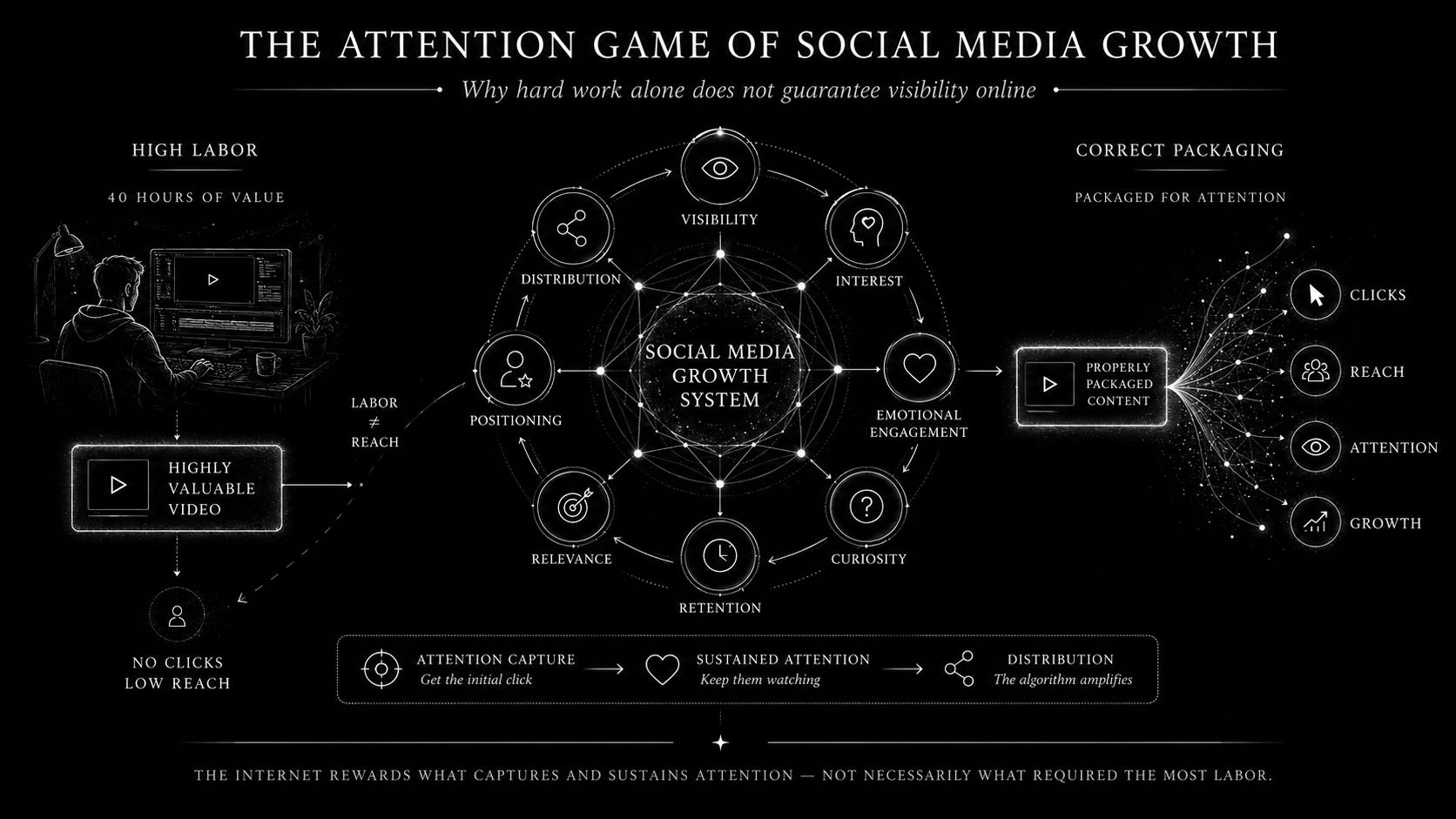
A creator can spend forty hours making a highly valuable video that nobody clicks on. Another creator can spend a fraction of that time making something packaged correctly and receive exponentially more reach. The internet rewards what captures and sustains attention, not necessarily what required the most labor to create.
I have outgrown the old assumption: “Just work harder and post consistently.”
This is difficult for many intelligent or value-driven creators to accept because they naturally focus on depth, quality, insight, and substance. Internally, it feels logical that the best information should rise naturally if enough effort is applied consistently. But online ecosystems do not function as pure merit systems. If nobody enters the room, the value inside the room becomes irrelevant from a distribution perspective. The problem is not always the quality of the content itself. Often the problem is that the content never successfully captured enough attention for the system to continue distributing it.
This realization changes how online growth must be understood. Consistency alone is not enough because consistency without feedback can simply reinforce ineffective patterns. Someone can continue posting for months while the market repeatedly signals that the packaging, positioning, framing, or audience targeting is not working. In nonlinear systems, more effort applied to the wrong leverage points does not necessarily improve results. Sometimes the correct move is not producing more output, but stopping long enough to analyze the mechanics of the system itself.
One of the biggest misunderstandings in online growth comes from people observing established creators and assuming that the same rules apply to beginners. They see creators posting consistently, speaking casually, uploading simple content, and still receiving views, subscribers, inbound opportunities, and engagement. From the outside, it appears as if consistency alone is the engine behind their growth.
What most people fail to recognize is that these creators are already operating from a completely different position inside the system.
There are effectively two different games being played online:
Distribution acquisition
Audience compounding
Most beginners confuse the second game for the first.
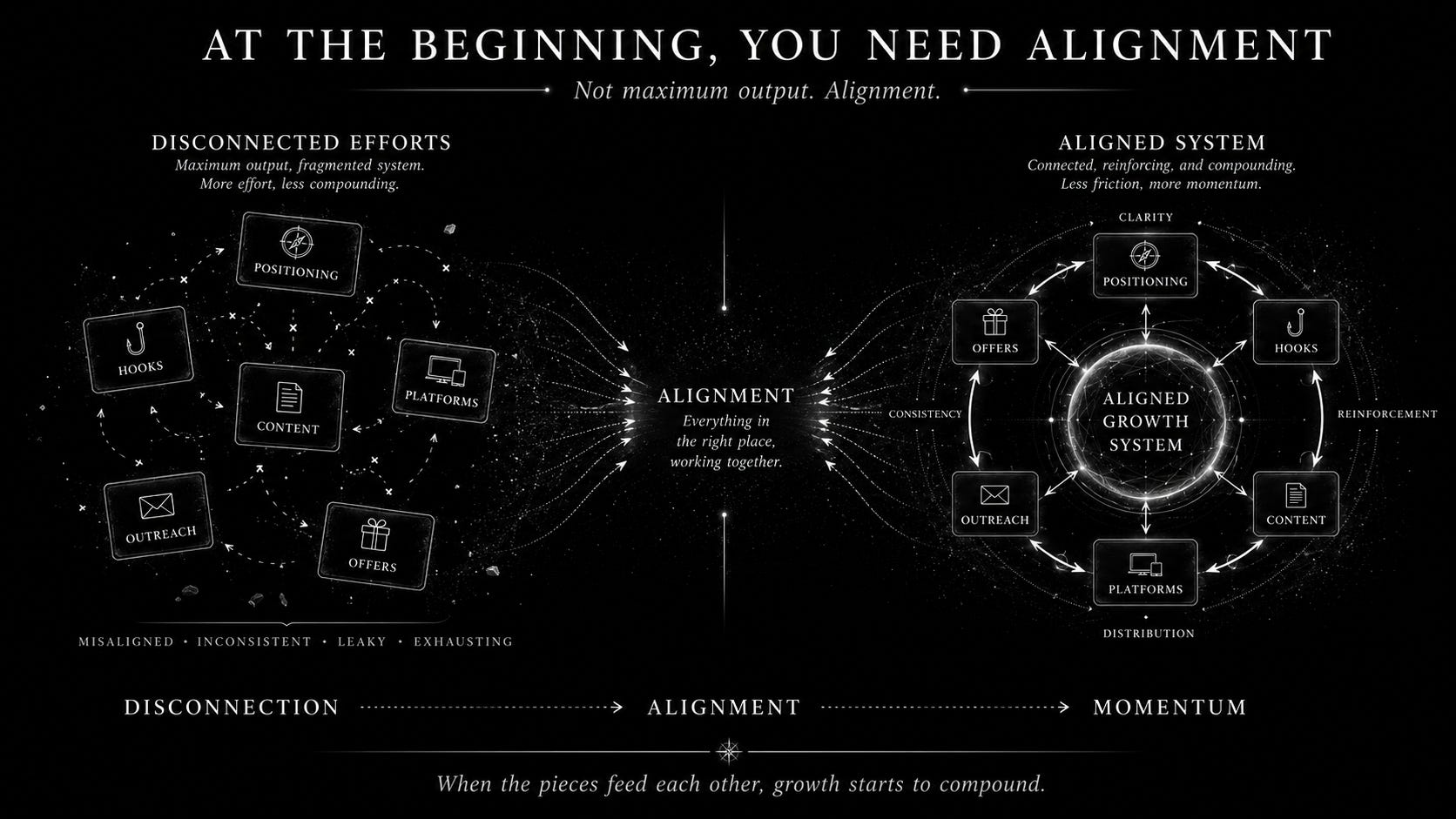
Meaning, your positioning, hooks, content, platforms, outreach, and offers must start feeding each other, instead of existing as disconnected efforts.
Get it through your thick skull that you need to learn and apply this.
The early stage of growth, especially from zero to the first few hundred or thousand followers or subscribers, is primarily about acquiring distribution. At this phase, the platform does not yet trust the creator. There is no audience momentum, no social proof, no established recommendation history, and no baseline traffic generated by existing followers. The creator is essentially unknown to both the algorithm and the market. Because of this, the system evaluates content very differently.
At the beginning, the primary challenge is not simply creating valuable content. The challenge is earning enough attention from strangers for the system to continue distributing the content. This is why hooks, thumbnails, titles, emotional framing, curiosity, positioning, and audience targeting become disproportionately important during the early phase.
Basically: Attention Engineering.
This is now a core skill you must learn. Meaning:
Hooks
Titles
Thumbnails
Opening lines
...are no longer optional details. They are part of the product itself. You need to dramatically improve your entry point.
Which I have to be honest, it is a game that I really did not want to play. But I have to if I want growth on social media to help with relevance, business, etc.
The creator is not merely competing with other beginners. They are competing against an endless stream of highly optimized entertainment, media, and content designed to capture attention immediately.
This changes the role of the creator. Early-stage creators are not simply content creators in the traditional sense. They are attention engineers. They are learning how to package ideas in ways that trigger curiosity and emotional engagement quickly enough for people to stop scrolling and pay attention. The internet initially rewards the ability to interrupt attention before it rewards depth.
This creates frustration for many thoughtful creators because they naturally prioritize substance, systems, philosophy, intelligence, and value. But the early stages of online growth reward entry points more than depth. A piece of content may contain extraordinary insights, but if the packaging fails to create enough interest initially, the market never reaches the value inside the content.
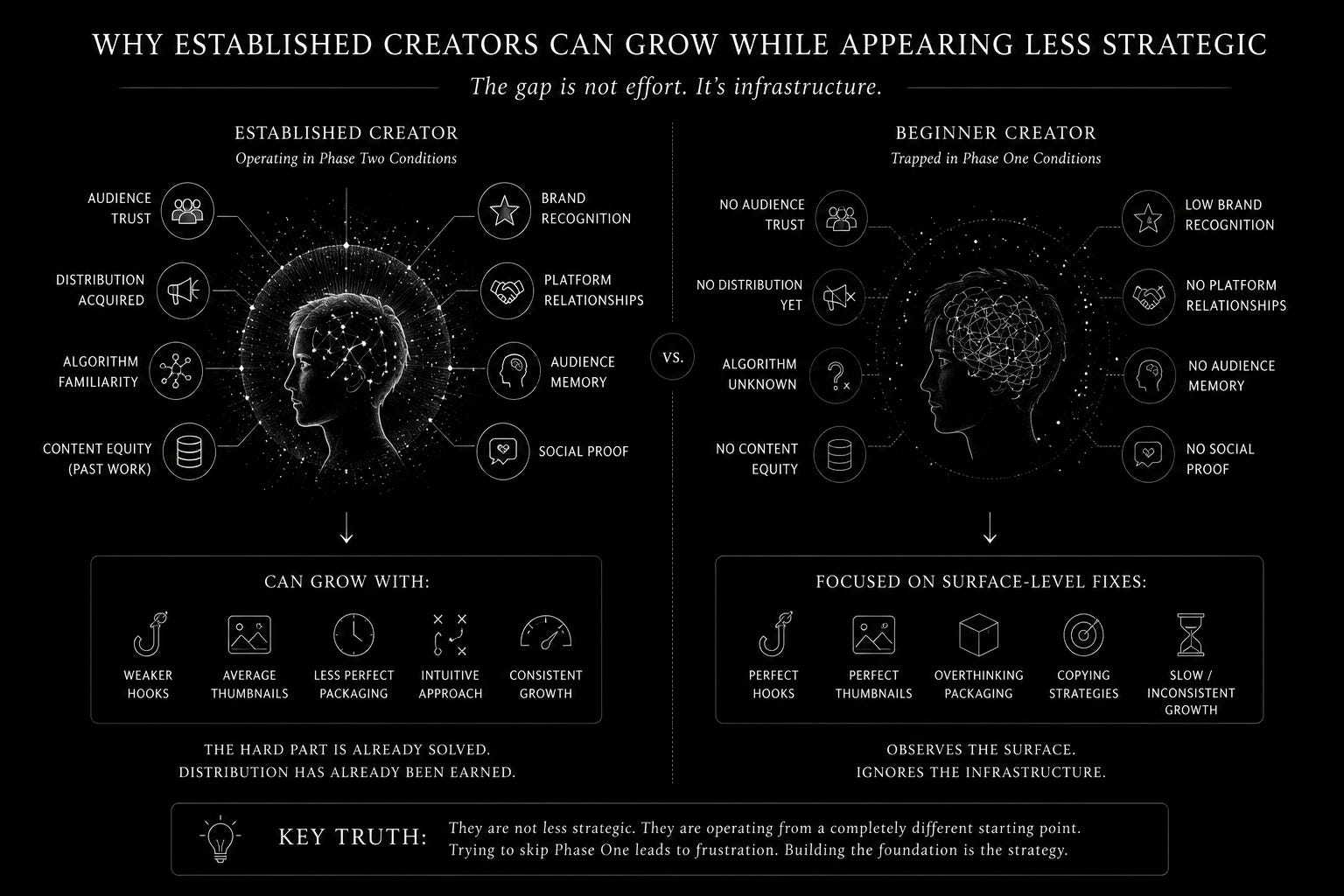
Once creators successfully acquire distribution and build an audience, the game begins changing. A creator with an established audience already possesses:
Algorithmic trust
Recurring viewers
Social proof
Recommendation history
Their uploads receive impressions automatically because the system already understands who is likely to engage with their content. At that stage, consistency becomes significantly more powerful because the creator already has access to distribution. Existing subscribers create baseline momentum, returning viewers strengthen engagement signals, and the platform has accumulated enough historical confidence to continue recommending their work.
This is why established creators can often grow while appearing less strategic with hooks, thumbnails, or packaging. The hardest phase has already been solved. Distribution has already been acquired. Beginners often observe the surface-level behavior of established creators without understanding the invisible infrastructure supporting their growth. They attempt to apply Phase Two strategies while still trapped in Phase One conditions.
Understanding this distinction changes the entire perspective on online growth.
Most people think they are simply publishing content, but platforms are not structured around passive publishing. They are structured around continuous testing. Every piece of content enters a feedback system where the platform attempts to determine whether broader distribution is justified. The beginning is not primarily about self-expression or simply sharing value consistently. It is about surviving the attention economy long enough to earn distribution. Only after that foundation exists does consistency begin compounding in the way most people imagine from the start.
Surviving the Initial Testing Phase
Understanding how platforms test content changes the way early-stage creators must think about growth. The primary challenge is not simply producing valuable content consistently. The primary challenge is surviving the initial testing phase long enough for the system to continue distributing the content to larger audiences.
This is where many creators fail to correctly diagnose the problem. They assume that if their content contains enough depth, intelligence, or value, growth will eventually happen naturally through consistency alone. But algorithms cannot directly measure the internal quality of an idea in the abstract. They measure human behavioral reactions to the packaging and presentation of that idea. If the content fails to generate enough engagement during the early testing phase, distribution slows before most people ever have the opportunity to experience the value inside it.
This is why packaging becomes so important at the beginning. Hooks, thumbnails, titles, framing, audience positioning, and emotional entry points are not secondary details. They are the mechanisms that determine whether the platform continues testing the content or stops distributing it entirely:
A weak title can prevent clicks.
A slow introduction can hurt retention.
Unclear framing can confuse the audience.
Poor positioning can attract the wrong viewers, generating weak engagement signals even if the underlying content itself is strong.
The consequence is that creators can misinterpret the situation completely. They may believe they lack intelligence, creativity, consistency, or discipline when the actual issue is that their content repeatedly fails the platform’s initial testing process.
More effort alone does not automatically solve this problem because effort applied without understanding distribution mechanics can simply produce more content that dies at the same stage.
This is why early-stage online growth becomes heavily connected to attention engineering. The creator’s job is not only to create valuable ideas, but to structure those ideas in ways that immediately communicate relevance, curiosity, emotional interest, or importance to strangers encountering the content for the first time. The internet rewards content that successfully earns continued distribution, and continued distribution depends on surviving the first layer of algorithmic evaluation.
Once this becomes clear, online growth stops looking like a pure consistency game and starts looking more like a system of leverage, positioning, behavioral psychology, and distribution mechanics. Valuable content still matters, but value alone is not enough if the system never receives strong enough signals to keep exposing that content to people.