

The Future Belongs to Asset Builders, Not Just Workers
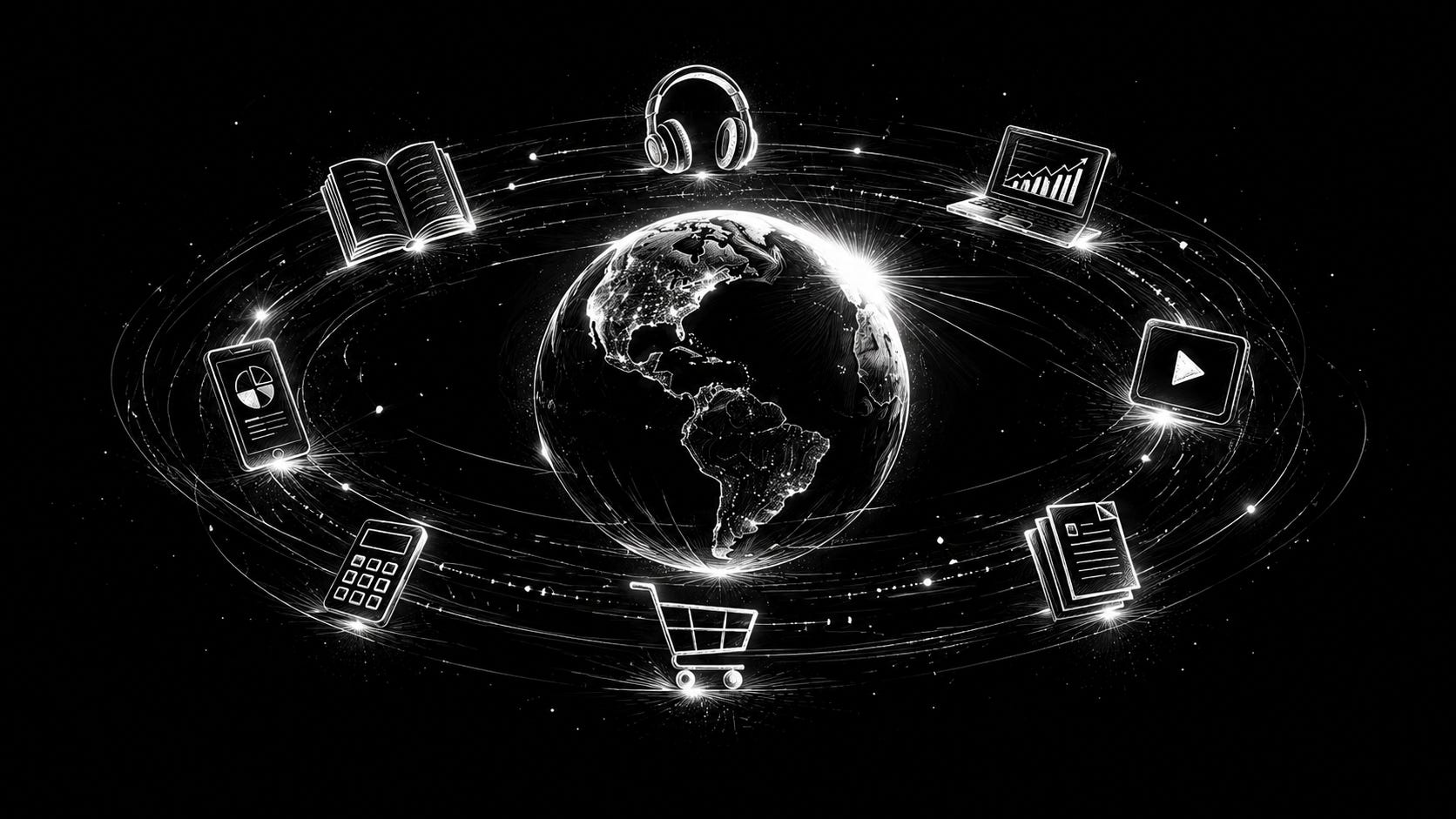
For most of human history, and still today, income has been directly tied to labor. You need to work, do, and perform to get paid.
A doctor gets paid when they see patients.
A consultant gets paid when they advise clients.
An employee gets paid when they show up to work.
The rule was always simple: no work, no income.
That has been changing thanks to the internet. Today, a person can create a book, an audiobook, a software tool, a digital product, or an online resource once and sell it repeatedly to people around the world. Instead of exchanging hours for dollars, they build an asset that keeps generating income long after the original work is finished.
You do the work once. The payments come many times.
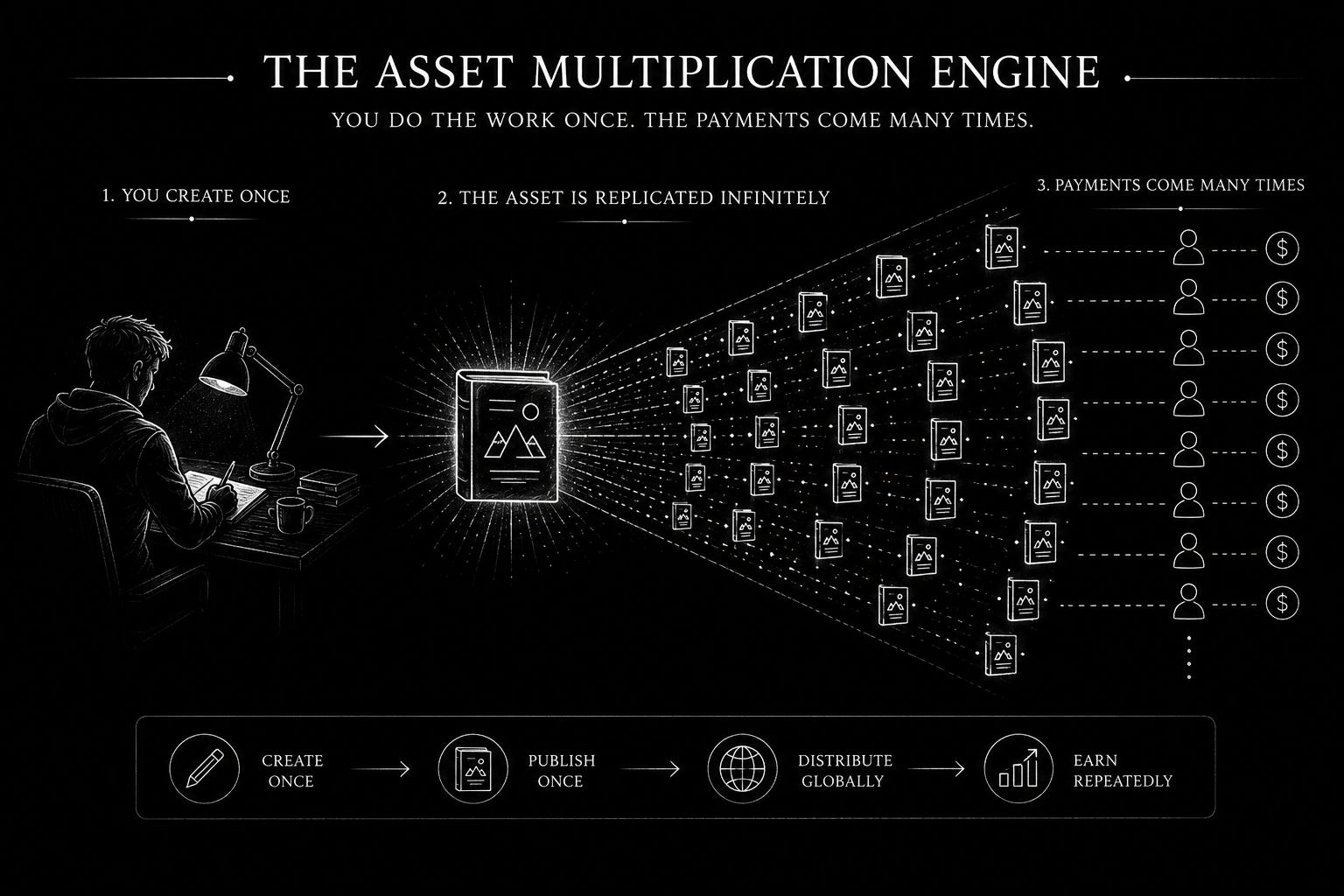
This is not a new phenomenon, it has been growing since the internet began, but artificial intelligence is accelerating it dramatically.
In the past, creating a digital asset often required a lot: teams, specialized skills, and significant capital. Building software required developers. Designing products required designers.
If you want to know exactly how to build these products using the free versions of AI apps, that's what I cover for members. Upgrade and I'll show you the specific process.
Today, AI can assist with writing, coding, design, research, editing, and product development. As a result, the cost and difficulty of creating digital assets are falling rapidly. You can now create many digital products with just a prompt and sell them over and over again.
So what I am saying is this: building is becoming less difficult. The hardest part is no longer creating the product. The hardest part is getting people to discover it.
The difficult part now is:
Attention
Trust
Discovery
Reputation
An existing audience
An existing customer base
The internet is already flooded with products. AI will flood it even more.
Things have shifted. Before, it was easier to build an audience and harder to build digital products. Today it is the inverse — easier to build digital products, harder to build an audience.
Attention, trust, reputation, distribution, and audience have become the new scarce resources. A great product that nobody sees struggles. A good product with strong distribution often succeeds.
Don’t be one of those entrepreneurs who spends months perfecting a product, launches it, and then discovers that the real challenge begins after launch — because nobody knows it exists.
EXAMPLE:
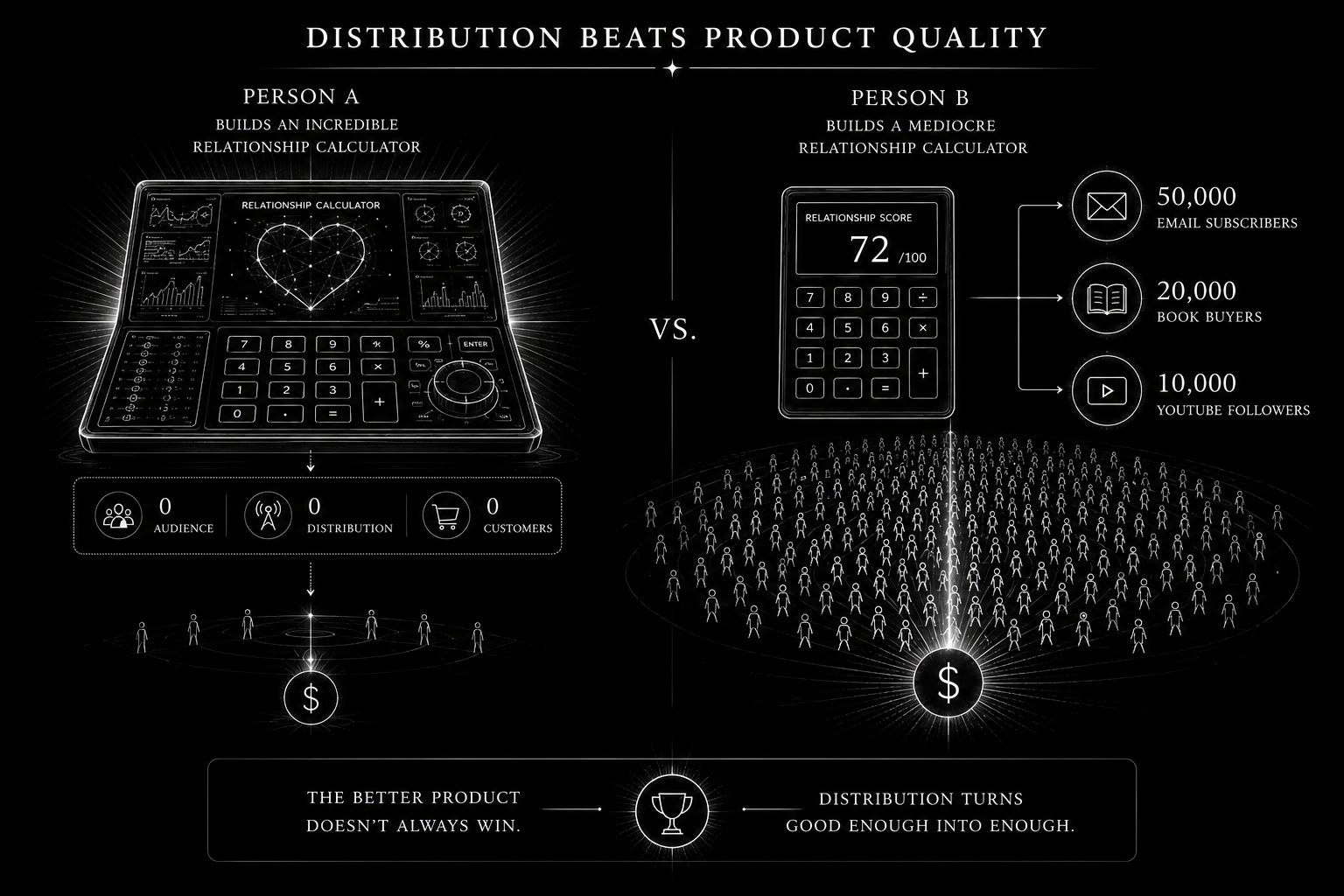
Person A builds an incredible relationship calculator.
Person B builds a mediocre relationship calculator.
But Person B has:
50,000 email subscribers
20,000 book buyers
10,000 YouTube followers
Person B will often make more money despite having the worse product.
As AI continues to make production easier, distribution becomes increasingly valuable.
The future digital economy will likely reward two complementary skills: creating assets, and building systems that bring attention to those assets.
Tools like relationship assessments, business calculators, financial simulators, health planning tools, and content strategy generators are incredibly scalable. One tool can serve millions of users. These products share an important characteristic: they can be created once and sold many times.
Now, I want to clarify something, because the idea of “doing the work once” is often misunderstood. Yes, the ongoing labor after launch is minimal — but it is rarely zero. Occasionally you need improvements, updates, and promotion. The maintenance is usually small compared to traditional employment, but it exists.
A single audiobook can sell while its creator sleeps. A software tool can serve thousands of users simultaneously. A digital resource can be downloaded endlessly without additional production costs.
And these assets do not have to exist in isolation. The most effective ones complement one another and form an ecosystem where each product naturally leads to the next.
A customer who buys a book may later purchase the audiobook. An audiobook listener may discover a digital tool. A user of that tool may purchase a premium playbook, a template library, or a membership. Rather than relying on a single product, creators can build a collection of interconnected assets that solve different parts of the same problem.
This creates a compounding effect. Every new asset not only generates revenue on its own, but also increases the value and visibility of the assets already in the ecosystem. Instead of building one product and hoping it succeeds, creators gradually assemble a portfolio of complementary products that support one another.
Over time, a modest audience can become surprisingly valuable. A creator with an existing customer base doesn’t need millions of followers if they can repeatedly offer useful, relevant products to the same market. As additional assets are added to the ecosystem, revenue can grow without requiring a proportional increase in labor.
This is one of the unique characteristics of the digital economy. A collection of books, audiobooks, software tools, calculators, playbooks, templates, and other digital products can function as a unified system — each asset strengthening the others, creating multiple income streams from the same audience.
I am doing this myself right now. I have income coming in that is not directly tied to my labor. I did the work once, and there is little work to maintain it. The challenge is getting more eyeballs on it, and that is what I am working on.
What makes this exciting is that winning is no longer tied to who puts in the most hours.