

Most people confuse long hours with real productivity, but they are not the same thing. Working ten or twelve hours a day creates the feeling of progress because you are constantly occupied, but being busy is not the same as moving forward. Time spent working does not automatically translate into meaningful output, and this is where the misunderstanding begins.
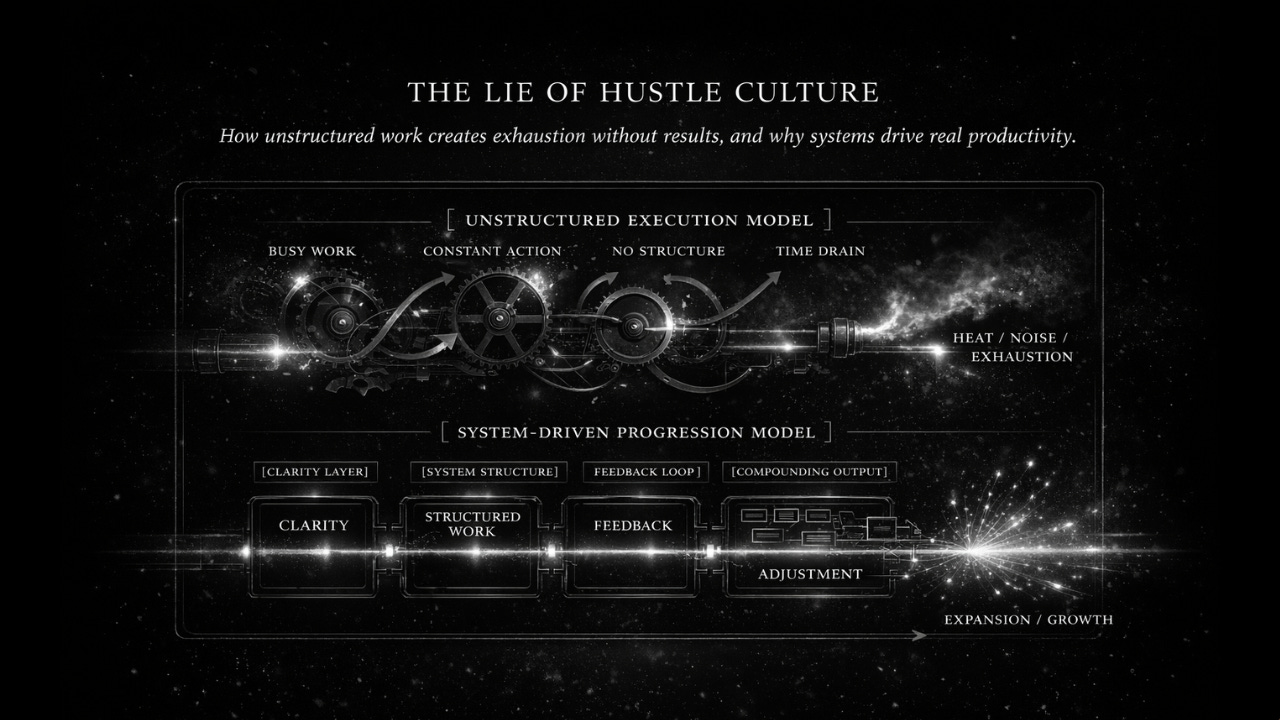
When you are on your laptop all day, switching between tasks and staying active, it feels like you are building something. In reality, for most people much of that activity is scattered and unstructured. You may complete small tasks and move things forward slightly, but without a clear structure, the effort spreads across multiple directions and loses force. The work becomes fragmented, and the results do not reflect the number of hours invested.
Activity → Movement → Fragmentation → Weak Output
If you prefer to listen instead of read, you can watch the full breakdown here.
The core issue is that activity is being mistaken for progress. Being occupied creates a sense of responsibility and effort, but it does not guarantee that anything substantial is being produced. A long workday filled with partial tasks and constant movement can leave you mentally exhausted while producing little that actually compounds or leads to meaningful outcomes.
Exhaustion as False Proof
This confusion persists because exhaustion feels like proof that work was done. At the end of a long day, you feel tired, and fatigue creates the impression of productivity, even when there is no clear output to point to. (You really did not get that much done).This reinforces the belief that more hours equal more progress, when in reality the structure of the work matters far more than the time spent on it.
Fatigue becomes a signal, but a misleading one. If little was done it exposes flaws in your inputs. It reflects energy spent, not results produced.
The Shift in Understanding
Once this distinction becomes clear, it changes how productivity is understood. The focus shifts away from how long you work and toward how the work is organized and executed. Without structure, hours expand and results remain limited. With structure, even fewer hours can produce the same or greater output because the effort is directed instead of dispersed.
Time does not create results. Structure does.
Unstructured work fails because it operates through constant interruption and scattered attention. The day is not driven by a defined sequence of actions but by reactions to incoming inputs. You move from one task to another without completing them, shifting between emails, content, messages, and administrative work. Each shift seems small, but it carries a cost.
Task Switching → Context Loss → Energy Drain
Attention is broken, context is lost, and mental energy is depleted faster than it is restored. This pattern creates a form of hidden friction that accumulates throughout the day. Every time you switch tasks, you are forced to reorient yourself, recall where you left off, and rebuild focus.
The more this happens, the harder it becomes to sustain deep work.
Fragmentation and Invisible Friction
Instead of progressing in a straight line, the work becomes fragmented into short bursts of partial effort. By the end of the day, you feel mentally drained, but the actual progress is unclear because nothing reached completion.
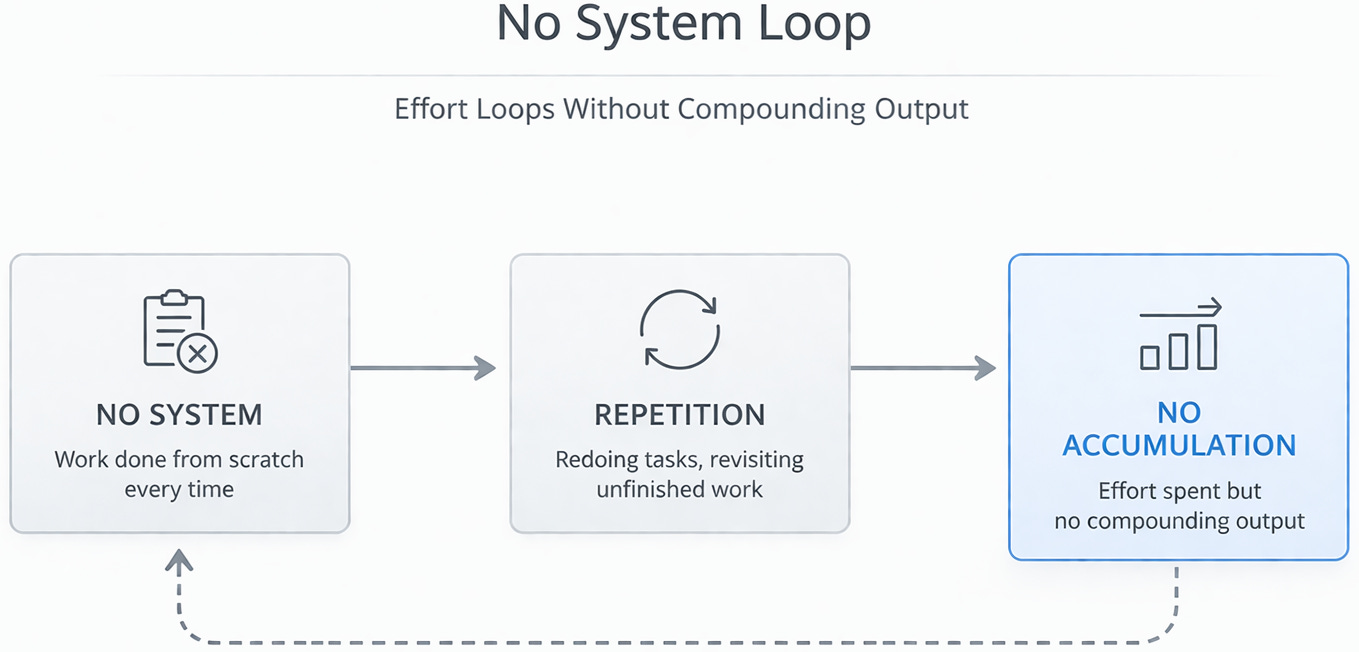
Without systemization, tasks are approached from scratch every time. There are no templates, no defined processes, and no structured way to continue where you left off. As a result, the same work is repeated in slightly different forms.
No System → Repetition → No Accumulation
You redo tasks that were already started, revisit ideas that were never finalized, and lose continuity between days. This creates loops where effort is spent without creating lasting output.
The Absence of Completion
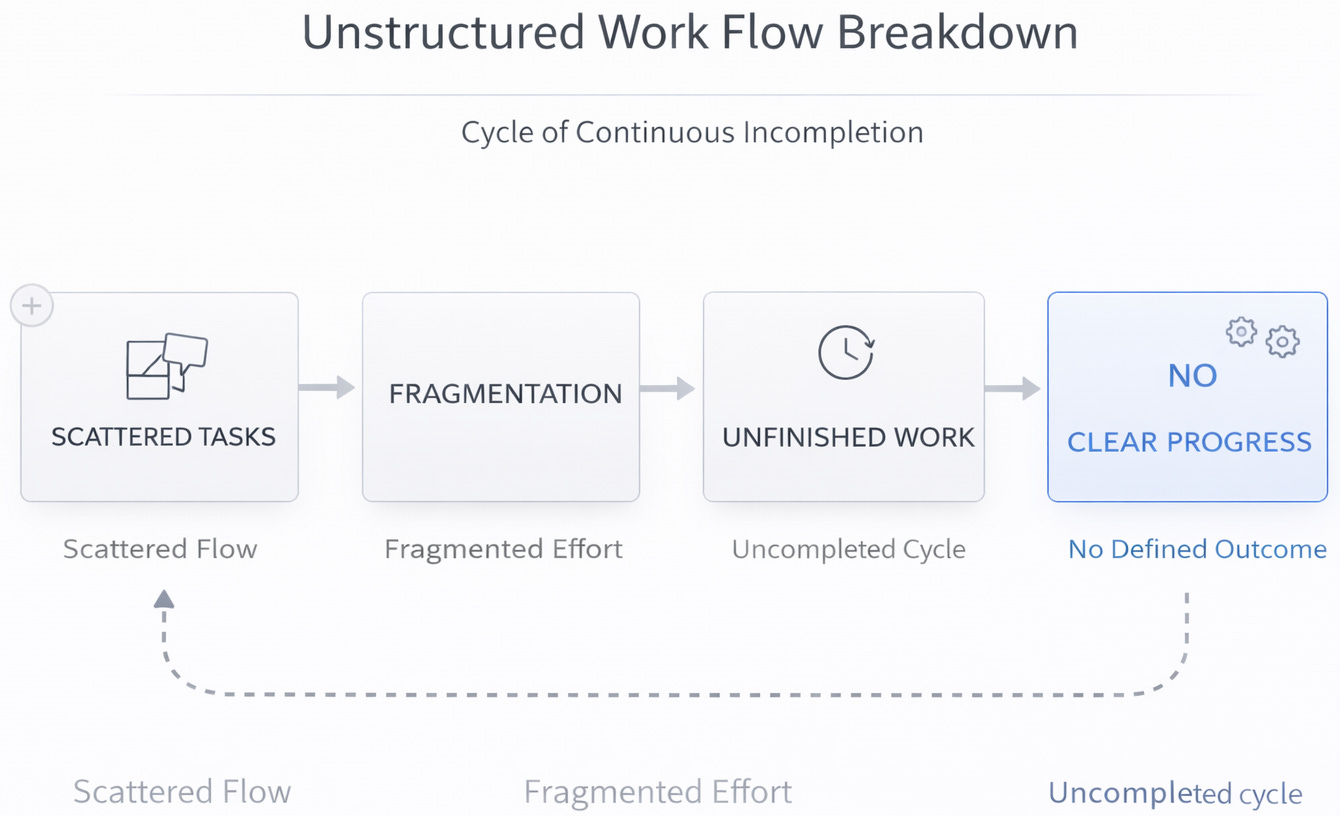
Another consequence of this structure is the absence of clear endpoints. Tasks are not defined by a specific result but by vague intentions such as “work on this” or “improve that.” Without a clear definition of what completion looks like, the work remains open-ended.
You make incremental adjustments, move things forward slightly, and then leave them unfinished.
When you return the next day, there is no clear path to continue.So the cycle repeats. People stay like this for years, Unfotunately.
This is why long, unstructured days feel productive while failing to produce meaningful results. The constant activity creates the illusion of progress, and the mental exhaustion reinforces that belief.
In reality, the lack of structure prevents effort from concentrating into output. Instead of building momentum, the work dissipates across multiple unfinished directions, leaving you busy but not advancing.
Constraint Creates Clarity
Reducing the number of working hours exposes how inefficient the work structure actually is. When the available time shrinks, it becomes impossible to continue operating in a scattered way. You can no longer afford to spend long periods deciding what to do, switching between tasks, or revisiting unfinished work.
Constraint removes excess.
What remains becomes visible.
What matters stays. What doesn’t disappears.
This is where clarity begins.
Structure Replaces Effort
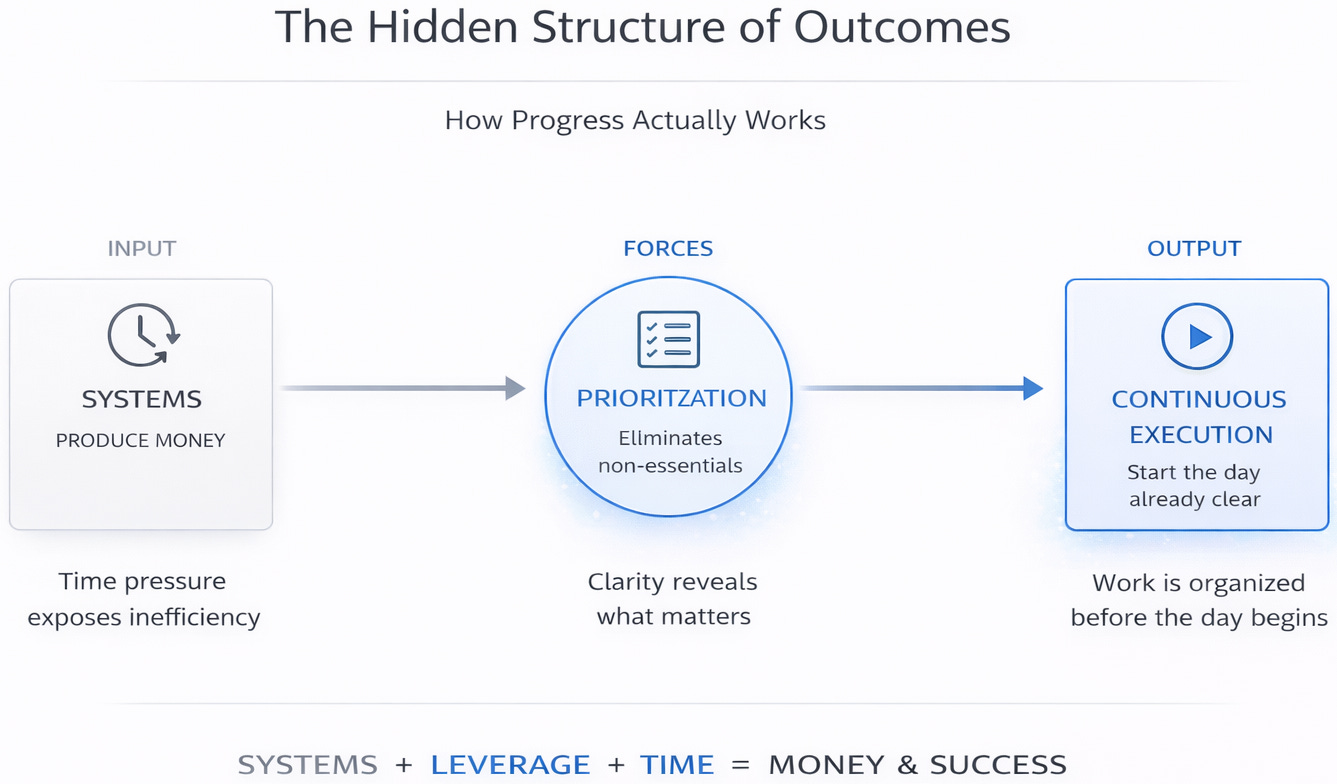
Reducing the number of working hours exposes how inefficient the work structure actually is. When the available time shrinks, it becomes impossible to continue operating in a scattered way. You can no longer afford to spend long periods deciding what to do, switching between tasks, or revisiting unfinished work. The constraint forces clarity. What matters becomes visible, and what does not gets removed.
Constraint removes excess.
What remains becomes visible.
Once this happens, effort is no longer used to compensate for inefficiency. Instead of relying on long hours to make up for a lack of direction, the work is organized before it begins. The next day is planned in advance, with tasks already decided and arranged in a fixed sequence. You are no longer starting the day by asking what to do. You are starting with a defined path.
This shift removes a large portion of hidden friction. When the workflow is predefined, decisions are no longer made during execution. The mental energy that was previously spent on choosing tasks, prioritizing, and switching contexts is preserved. Instead of interrupting the work to decide what comes next, you move from one step to the next without breaking focus. Execution becomes continuous rather than fragmented, and attention remains on producing results instead of managing decisions.
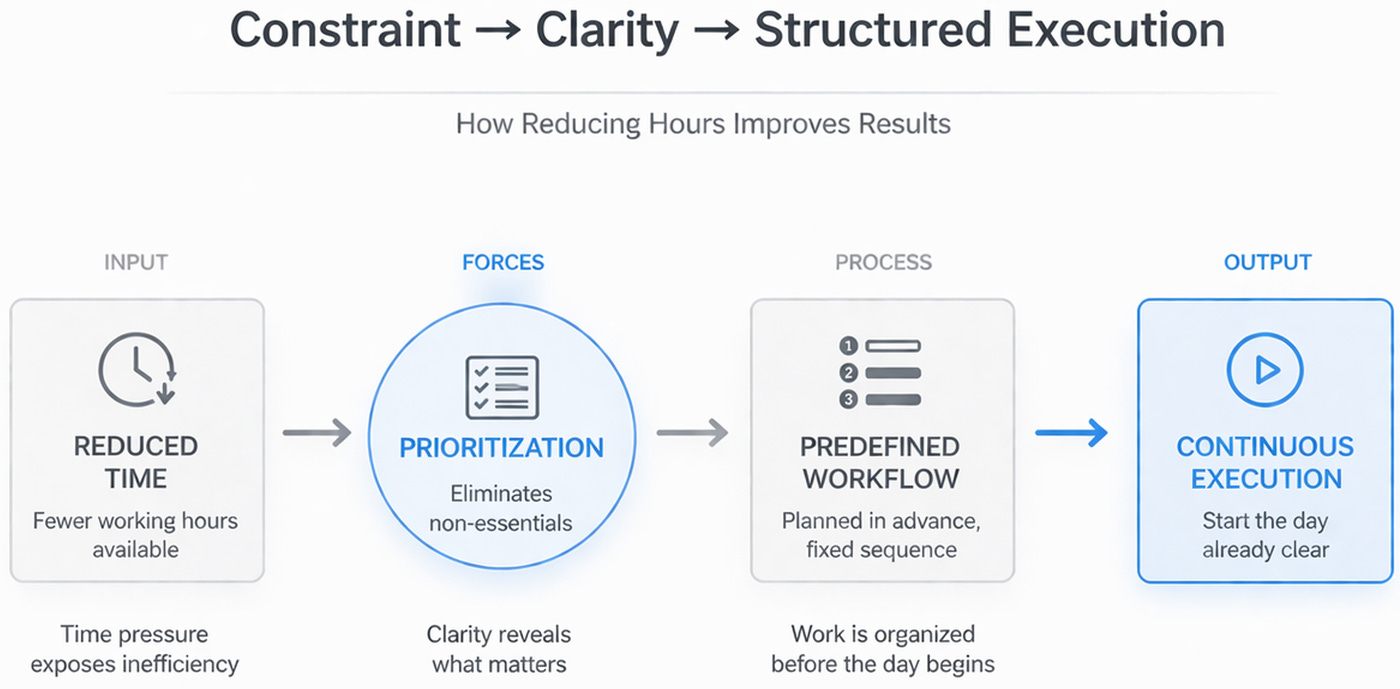
Plan → Sequence → Execute
As a result, productivity changes at its core. The focus moves away from managing time and toward managing structure. Work is no longer a series of reactions to incoming inputs, but a sequence of planned actions leading to a specific output. Each step has a defined role, and each task contributes to a clear result. Because the path is already established, effort is concentrated instead of dispersed, and fewer hours are required to produce the same or greater output.
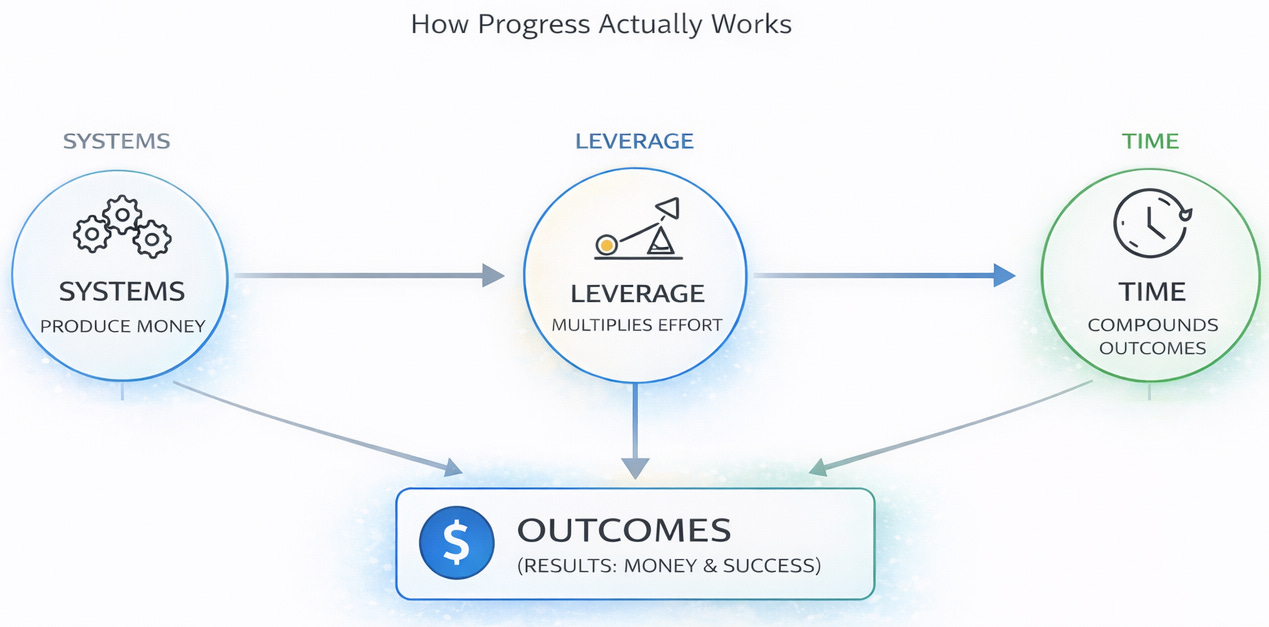
This exposes the limitation of the traditional model of work. Hustle culture assumes that output increases with time, that the person who works longer produces more. That relationship made sense in environments where effort was directly tied to production, but it no longer holds in the same way. Modern work, especially in one-person businesses, is not driven by time spent but by how the work is structured. What matters is not how long you are active, but what systems are in place and how they operate.
When systems are introduced, work begins to detach from constant input. Instead of relying on repeated effort, processes are created that can be executed consistently with less friction. A system can continue operating without requiring continuous attention, a piece of work can produce results long after it is completed, and an automated process can remove the need for repeated decisions. These elements do not scale with hours worked. In many cases, they reduce the need for additional hours entirely.
System → Consistency → Predictable Output
At this point, working longer hours often signals that something is not structured properly. If the work depends entirely on your constant presence, then it behaves like a job rather than a system. Progress stops when you stop, and output remains tied directly to time. This prevents any form of compounding and limits how much can be produced.
The shift, then, is not toward working less, but toward improving design. Instead of asking how to increase effort, the question becomes how to build processes that require less direct input. When the work is structured in this way, output is no longer constrained by hours. The focus moves to creating systems that generate results consistently, allowing fewer hours of focused work to produce more meaningful outcomes.
From Execution to Design
This change also redefines the role of the individual within the work. Instead of operating inside the process, handling each step directly, you begin to operate above it, focusing on how the process is structured and how it produces results. The role shifts from execution to orchestration.
In a task-based approach, progress depends on continuous effort. Each result requires direct input, and once the work stops, the output stops as well. This creates a dependency on time and limits how much can be produced. In a system-based approach, the focus shifts to building processes that continue to function with less direct involvement. The work is designed so that outputs can be generated consistently, even when effort is reduced.
Tasks → Linear Output
Systems → Compounding Output
This shift changes how decisions are made. Instead of reacting to tasks as they appear, decisions are embedded into the system itself. The structure defines what needs to happen, in what order, and with what tools. Execution becomes a matter of following a defined path rather than constantly choosing what to do next. This reduces uncertainty, preserves attention, and allows focus to remain on producing results.
At a broader level, this reflects a change in how productivity is understood. It is no longer measured by visible effort or time spent, but by the effectiveness of the system producing the output. The emphasis moves toward clarity, organization, and design. The individual is no longer evaluated by how much they do, but by how well the system they operate generates results.
As this perspective becomes more common, the advantage shifts toward those who can design clear, efficient systems and operate within them consistently. Work becomes more stable, less reactive, and more predictable. Instead of managing tasks throughout the day, the focus is on maintaining and improving the system that produces them.
From Structure to Execution
The shift from understanding to implementation begins by translating structure into concrete operating rules. Without this step, the concepts remain abstract and do not affect how work is actually performed. The goal is to move from general awareness to specific constraints that shape daily execution. These constraints are not additional tasks, but adjustments to how work is approached.
This requires identifying where inefficiency enters the system and removing it deliberately. You observe how work is currently done, where decisions are being made, and where time is being lost. Instead of trying to improve everything at once, the process is incremental. Small structural changes are introduced, and their effect on output and efficiency is observed over time.
Observe → Identify → Adjust
These changes operate at a second level. They are not focused on the surface of the work itself, but on how the work is organized. The objective is not to increase effort or speed, but to reduce unnecessary decisions, eliminate repetition, and create consistency. As these adjustments accumulate, the system becomes easier to operate. The path from starting a task to completing it becomes clearer, and fewer resources are required to move through it.
Over time, this produces a visible shift. What once required constant attention and long hours becomes more manageable and more efficient. The principles are no longer ideas to consider, but rules that guide how work is done. Execution becomes simpler because the structure carries part of the load.
Output, Assets, and System Efficiency
Productivity begins before execution by defining a clear output. Instead of starting the day by deciding what to work on, the outcome is determined in advance. This removes the need to spend time choosing tasks once work begins. When the output is clearly defined, attention is directed toward completing a specific result rather than navigating options.
Without this definition, the workflow becomes reactive. You begin by evaluating possibilities, prioritizing tasks, and deciding where to start. Each of these decisions consumes mental energy and fragments attention before any meaningful work is done. By the time a direction is chosen, part of your cognitive capacity has already been depleted, making execution less effective.
The solution is to separate thinking from doing. Decisions about what to work on, how to approach it, and in what order are made ahead of time. When execution begins, there is no need to evaluate or reconsider. The path is already established, allowing the work to progress continuously without interruption.
Define → Execute → Complete
This continuity improves both speed and quality. Instead of pausing at each step, the system determines what comes next, and attention remains on the current action. The work becomes more predictable because it is guided by structure rather than by moment-to-moment decisions.
At the same time, the nature of work shifts from isolated tasks to reusable assets. Most work is treated as something that is completed once and then disappears. It requires the same effort each time it is repeated and does not accumulate value over time. This creates a cycle where effort is continuously spent without building anything that lasts.
When work is structured around assets, this pattern changes. Templates, documented processes, frameworks, and reusable components allow work to build on itself. Instead of starting from zero, each new task begins from an existing foundation. Over time, these assets are refined and improved, increasing their effectiveness without requiring proportional effort.
Task → Temporary Effort
Asset → Reusable Leverage
This introduces continuity into the system. Past work begins to support future work, and output is no longer tied to isolated effort. As assets accumulate, repetition decreases and the workload becomes more manageable. Fewer hours are required because the system retains and reuses what has already been built.
AI, Energy, and Final Integration
AI becomes effective only when it operates within this structure. Its role is not to generate more output for its own sake, but to reduce friction inside an existing system. When processes are already defined, AI can assist by producing drafts, organizing information, and handling repetitive transformations. This allows work to begin at a more advanced stage instead of starting from zero each time.
When AI is used without structure, the result is different. More content is produced, more ideas are generated, but without direction, this output lacks coherence and purpose. Instead of improving productivity, it increases noise. The underlying inefficiencies remain because the system that defines what matters is still missing.
Structure + AI → Acceleration
No Structure + AI → Noise
Used correctly, AI shortens the path between intention and execution. It reduces time spent on formatting, rewriting, and basic structuring, allowing attention to remain on higher-level decisions. Work shifts from manual construction to guided refinement.
At the same time, mental energy becomes a limiting factor that must be managed deliberately. Even with efficient tools, performance depends on the quality of attention applied to the work. When energy is depleted, decision-making weakens and the effectiveness of the system declines. This makes energy a resource that must be protected in the same way as time.
This changes how the day is structured. Work that requires focus is done when energy is highest, while less demanding tasks are placed later. Similar activities are grouped together to avoid unnecessary switching, and breaks are used to restore clarity before fatigue accumulates. This prevents the gradual decline in performance that occurs when work continues without recovery.
High Energy → Deep Work
Low Energy → Shallow Work
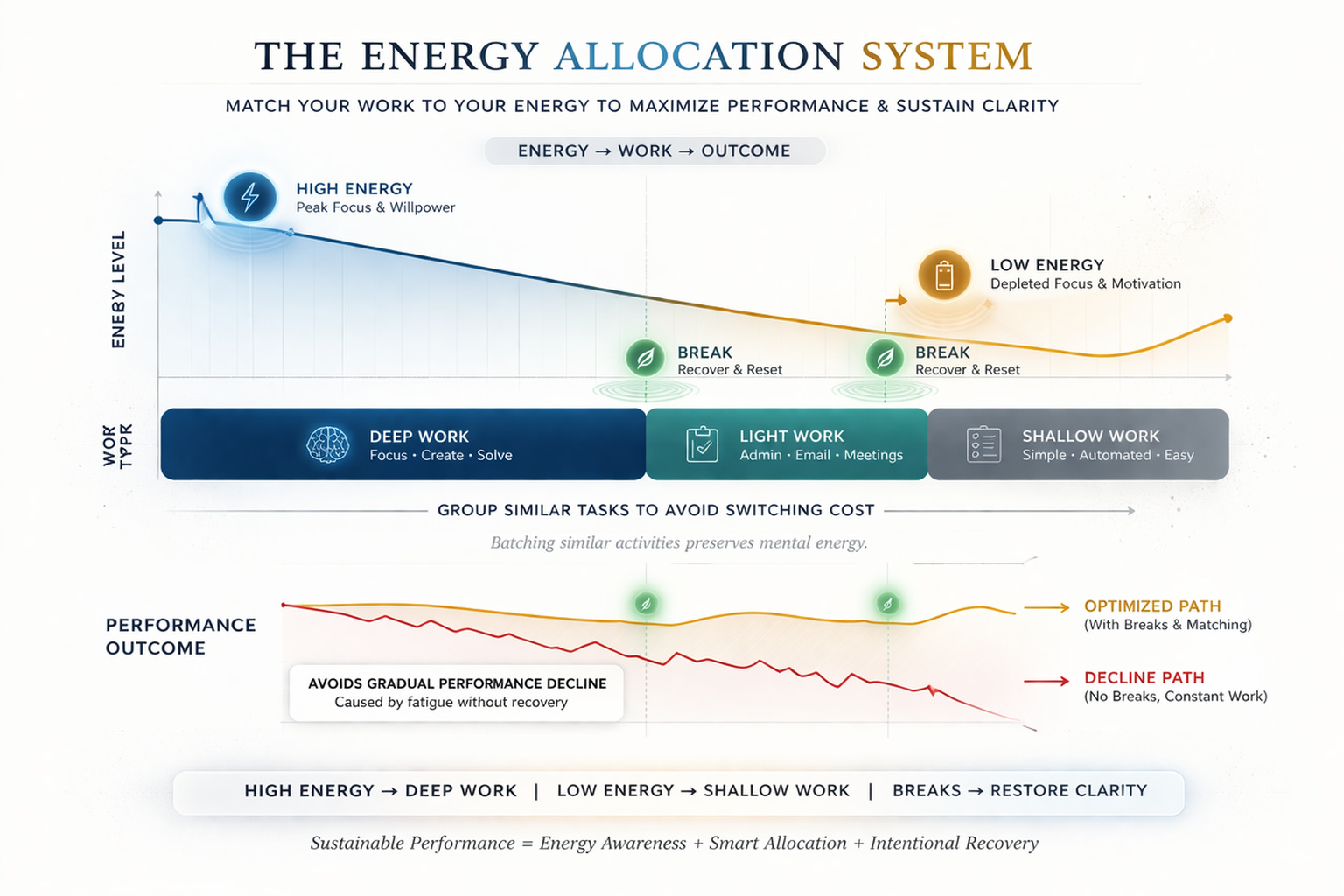
By combining structured workflows, asset-based work, AI-assisted execution, and deliberate energy management, the system becomes stable and efficient. Friction is reduced, attention is preserved, and output becomes more consistent.
The result is a complete shift in how productivity is understood. Working less and producing more is not the result of reducing effort, but of structuring it. When outputs are defined in advance, decisions are removed from execution, assets accumulate, and tools reduce friction, the time required to produce meaningful results decreases.
Productivity is no longer measured by hours worked or exhaustion felt, but by the clarity of the system and the consistency of its output. When the structure is correct, the need for long, unstructured workdays disappears because the system itself carries part of the work.
Structure determines output.