

The Paradox of Making Money Online
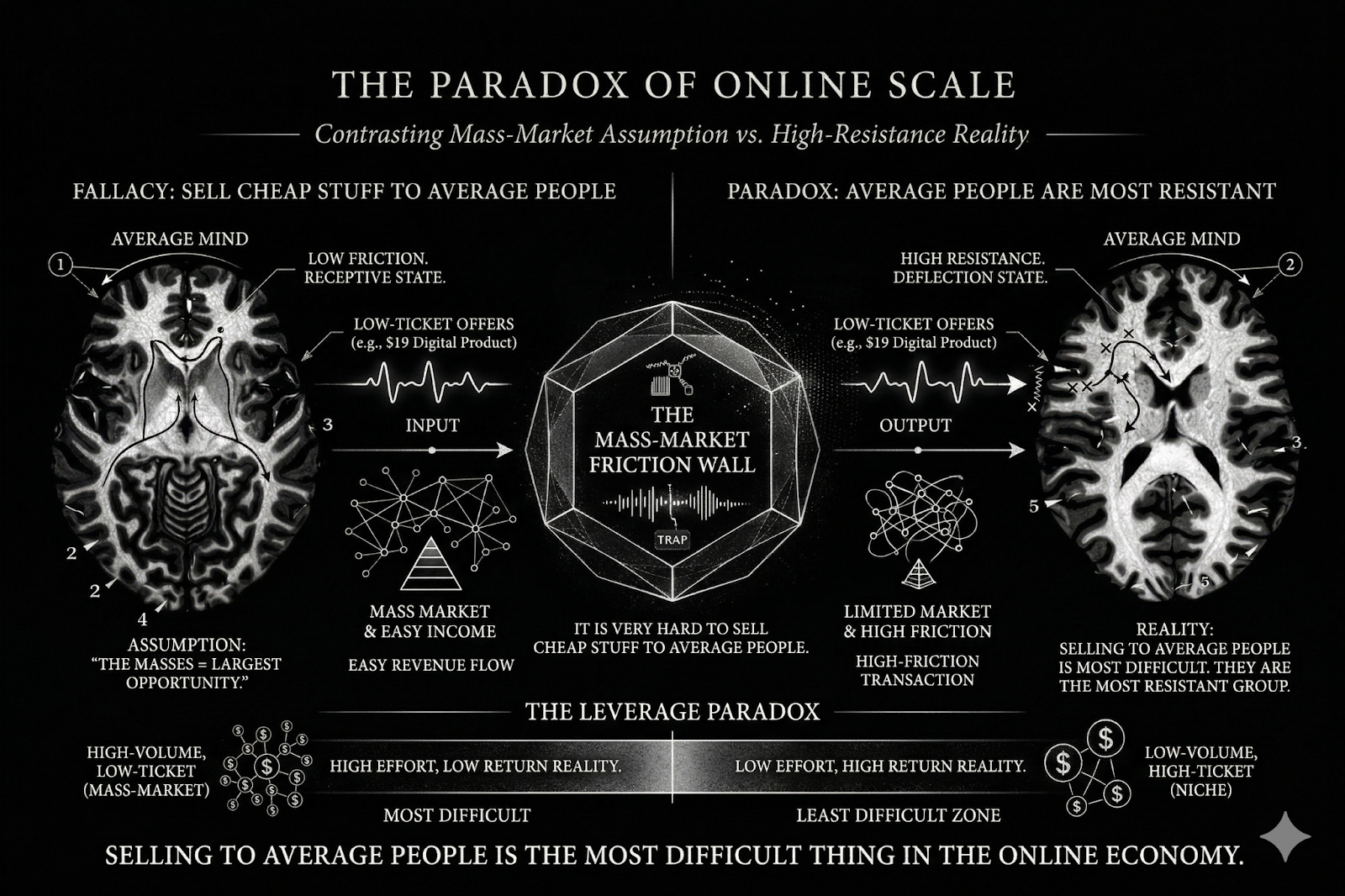
I have came to learn that selling to average people is one of the most difficult things to do in the online economy, even though most business models are built around that assumption. The idea is that the masses represent the largest opportunity, But in practice they are the most resistant group when it comes to spending money on digital products, services, or consulting. It is very hard to sell cheap stuff to average people.
WATCH THE VIDEO HERE:
People earning typical wages ($18-$25 usd an hour) operate within tight constraints where most income is already allocated toward essential expenses, so any additional purchase is evaluated not as an opportunity, but as a risk or tradeoff against something necessary.
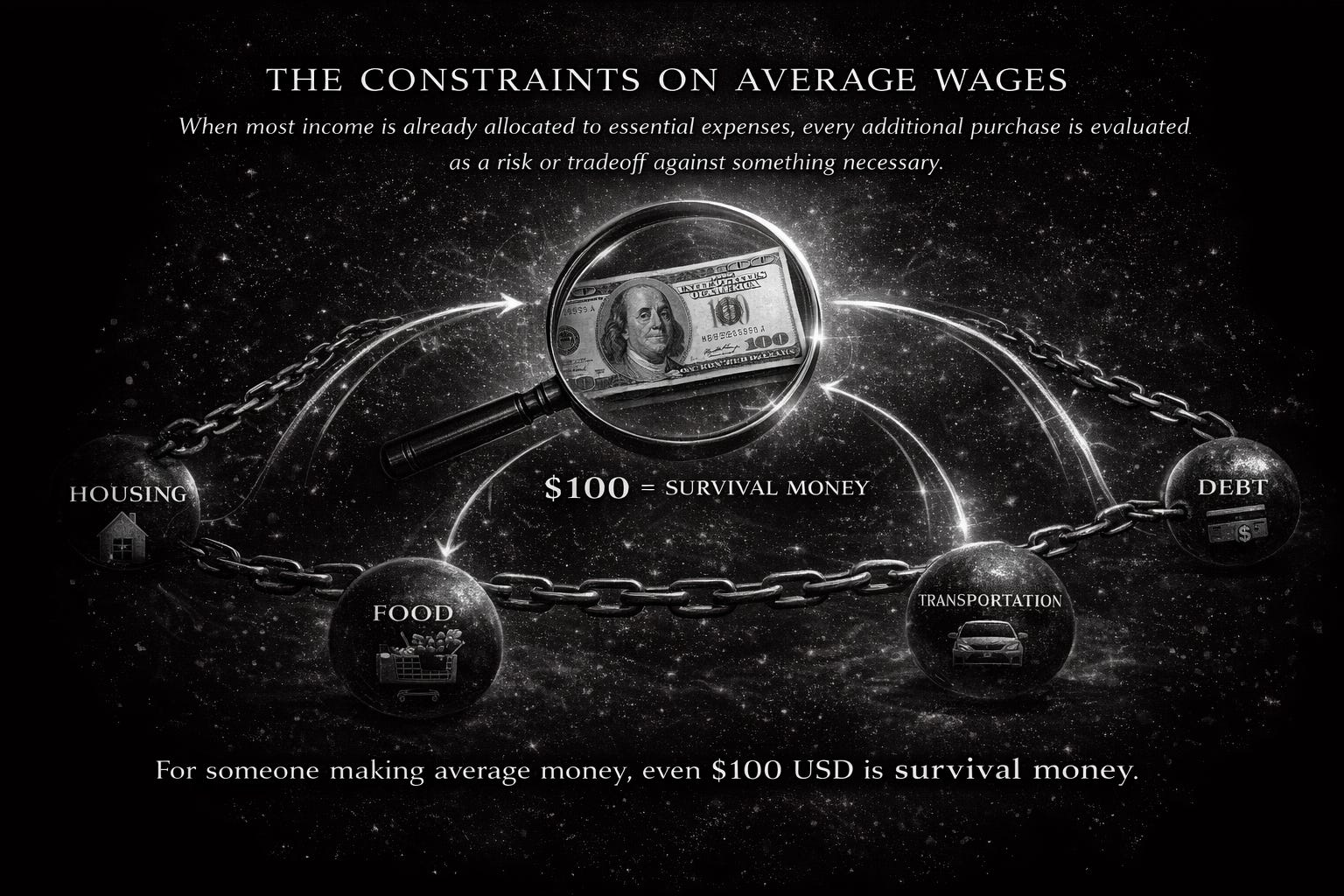
Here spending becomes difficult to justify, even when value is understood. If something can be done without paying, it will almost always be done that way. Average people have this DIY mindset.
When income is already allocated, spending is substitution.
Every purchase replaces something necessary, so even small amounts carry weight.
Default Behavior → Conserve Money → Substitute Effort
The default approach is to conserve money and substitute effort instead, leading to a preference for doing things themselves independently. Many of these people have awareness of what needs to be done but limited resources.
EVEN IF SOMEONE UNDERSTAND THE VALUE OF YOUR PRODUCT AND SERVICE AND WANT IT. THEY MAY NOT PAY IT BECAUSE THEY CAN’T
When money is tightly managed, the threshold for spending increases, and even small purchases can feel unnecessary.
At the same time, individuals with higher income or access to capital operate under a different framework. Amounts that would be significant for others are no longer tied to survival, but to allocation. The question shifts from affordability to whether something is worth it or not. This makes them easier to sell to, because purchases are evaluated in terms of return or efficiency rather than cost.
The IRONY: it’s actually easier to sell higher-priced products and services to people with money than it is to sell cheaper ones to the average person.
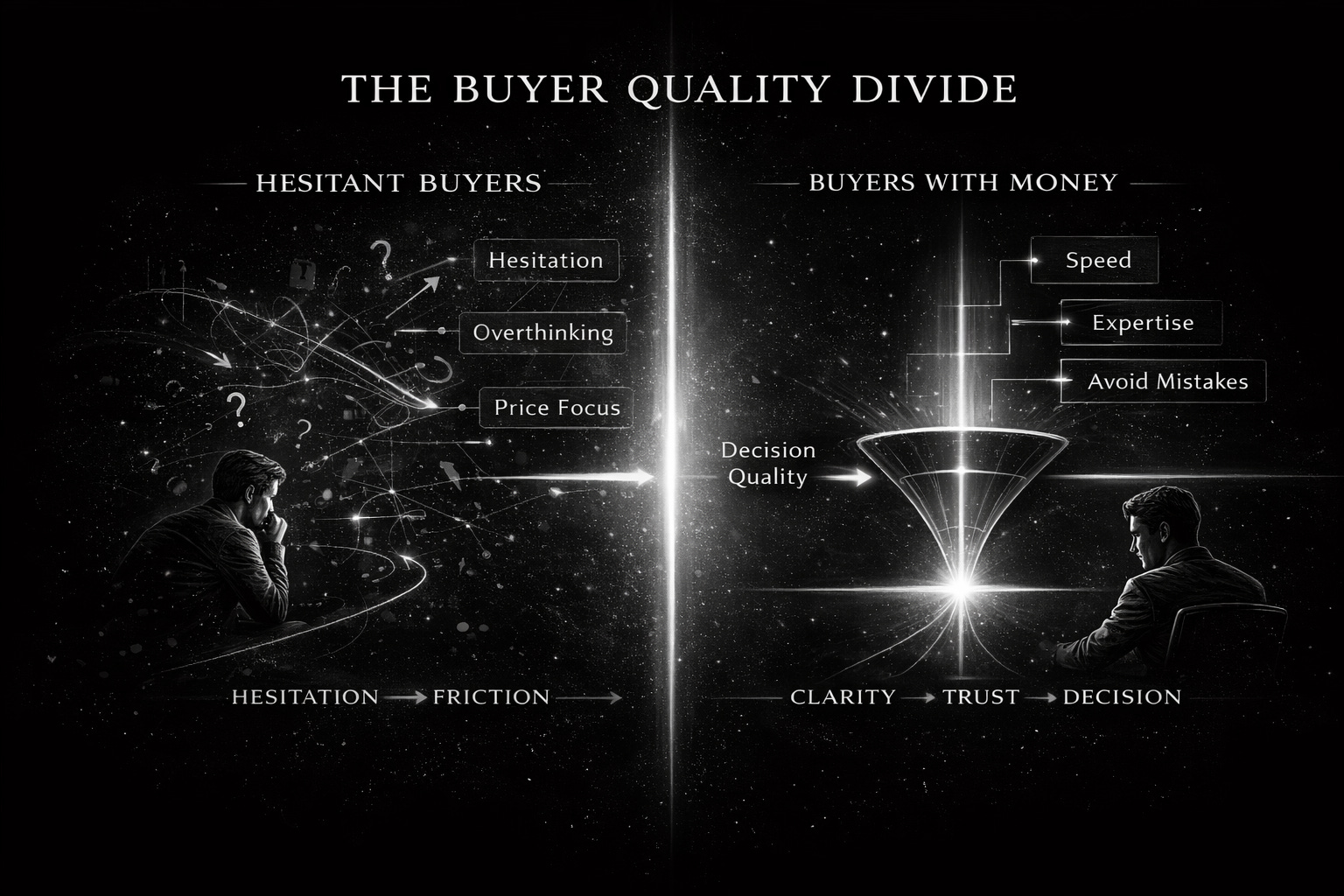
Buyers with money are better buyers
They don’t hesitate as much. They’ve already accepted:
Paying for speed
Paying for expertise
Paying to avoid mistakes
Paying to remove a problem that is bothering them
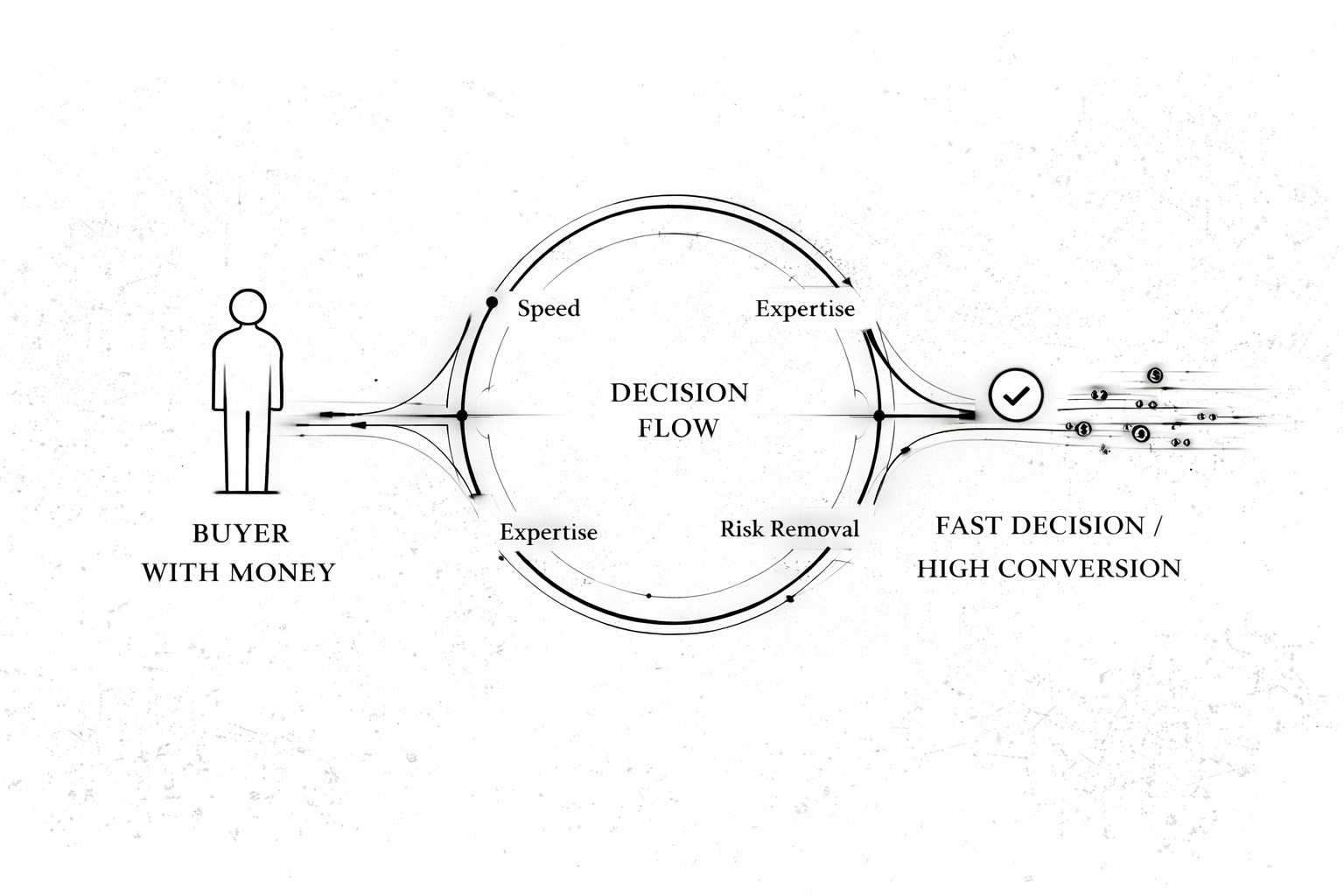
So the sales process becomes more about fit and trust, not convincing.
This creates a structural mismatch: the largest segment of the market is the hardest to convert, while smaller, more capitalized groups are more responsive. The issue is not the offer itself, but the economic conditions of the people being targeted and the behavior that emerges from those conditions.
When you sell:
Cheap offers → attract effort-first people
Expensive offers → attract outcome-first people
And outcome-first people are:
Easier to close
Less resistant
More decisive
Willing to get something done or to fix a problem
Alongside this, a second mechanism reinforces the behavior: the tendency to replace spending with effort. When time is perceived as more available than money, individuals choose to invest time into learning and solving problems themselves (DIY Mindset). If people believe they can do something themselves and money is tight, they prefer to solve these problems themselves without external cost because Time is more constrained than money.
Time-Rich → Replace Spending with Effort
Money-Rich → Replace Effort with Spending
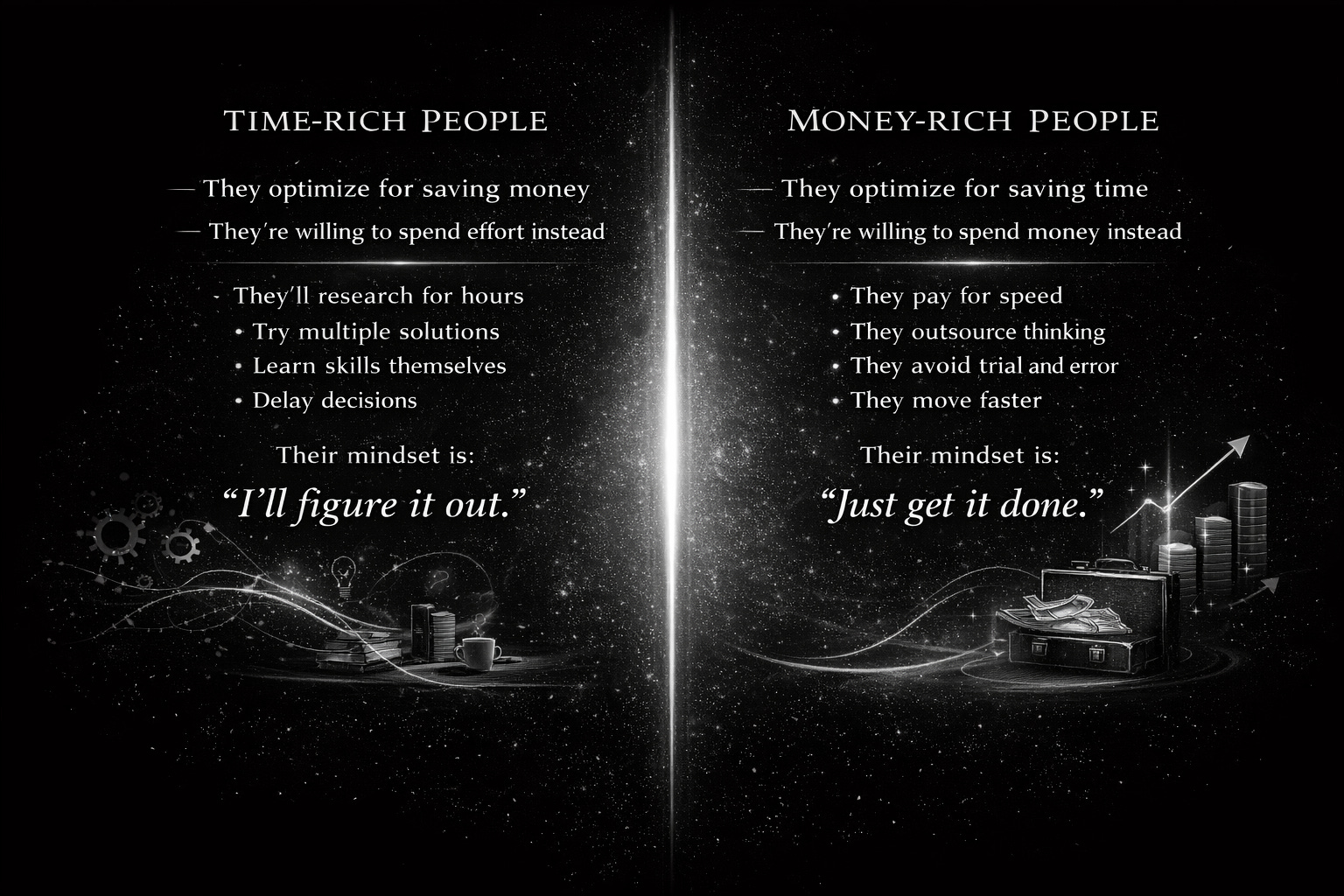
This distinction also changes how value is perceived. In constrained environments, value is measured by minimizing expense. In resource-abundant environments, it is measured by maximizing return or reducing friction. The same offer is interpreted differently not because it changes, but because the framework used to evaluate it is different.
So the same offer gets interpreted differently depending on the environment you are presenting it
The Internal Mirror of the Market
This pattern is not only external but internal. The same behavior that makes the market difficult to sell to can be observed at the individual level. When operating with limited disposable income, the default approach is to avoid paying for solutions that can be developed independently, even if this requires more time or leads to slower outcomes, which in most situations that is the case.
The decision is not based on whether external help would accelerate progress, but on whether the cost can be avoided. In other words they are thinking how they can do what you are offering so they can get it done themselves and save the money. So self-reliance becomes the preferred strategy. Learning, experimenting, and solving problems without assistance are seen as acceptable, even if they do need the outside help. The priority remains on conserving money rather than optimizing time.
This does not reflect a rejection of value, but a higher threshold for what justifies spending. It is not about how useful something is, but the if there is a path that does not require payment. As long as that alternative exists, it remains the preferred option, even if it is less efficient.
When applied across a large group, this creates predictable outcomes where offers based on convenience or speed struggle to gain traction. The underlying priority is cost avoidance, not efficiency. When money is limited and time is available, individuals substitute time for spending, expanding effort to avoid cost. Solving problems independently aligns with preserving resources.
As financial capacity increases or time becomes constrained, this relationship shifts. The focus moves from whether something can be done independently to whether it is the best use of time. Spending becomes a mechanism to reduce friction and accelerate outcomes rather than considering it a loss or taking it as survival money.
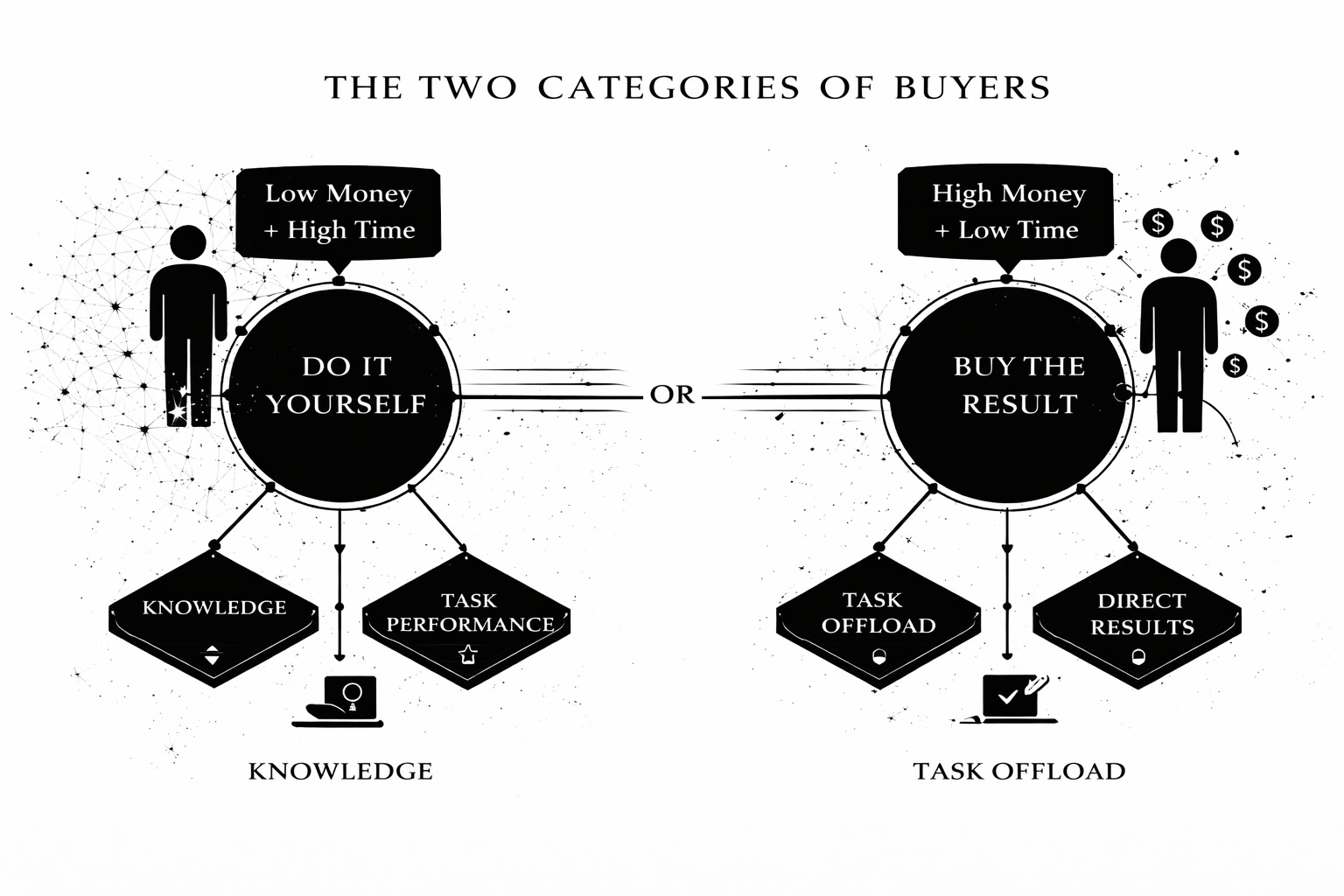
Low Money + High Time → Do It Yourself
High Money + Low Time → Buy the Result
This creates two categories of buyers: One group seeks to acquire knowledge and perform tasks themselves, while the other seeks to offload tasks and obtain results directly.
The first group values understanding and replication, making them more cost-sensitive. The second group values impact within a system, they don’t have that much sensitivity and they are more willing to spend money because at that point it becomes a matter of allocating money to them.
The Layers of the Online Economy
These differences extend into the structure of the online economy, where distinct layers emerge based on how money flows and value is created. At the base is the mass consumer layer, composed of individuals seeking improvement through information and low-cost solutions. This layer depends on scale, has low price points, and high competition, making conversion difficult.
Above it is the operator layer, where individuals run systems that generate revenue. This group includes founders, agency owners, and consultants who focus on improving or expanding already existing systems. They engage with services that provide direct results, such as implementation or optimization, and require fewer clients due to higher transaction value.
Further up is the infrastructure layer, composed of tools and platforms that businesses depend on. Customers here are organizations requiring reliable solutions, and value is delivered through functionality and integration, often through recurring payments.
At the top is the capital layer, where resources are allocated across systems that produce returns. Participants operate at a larger scale, focusing on performance and scalability rather than individual transactions.
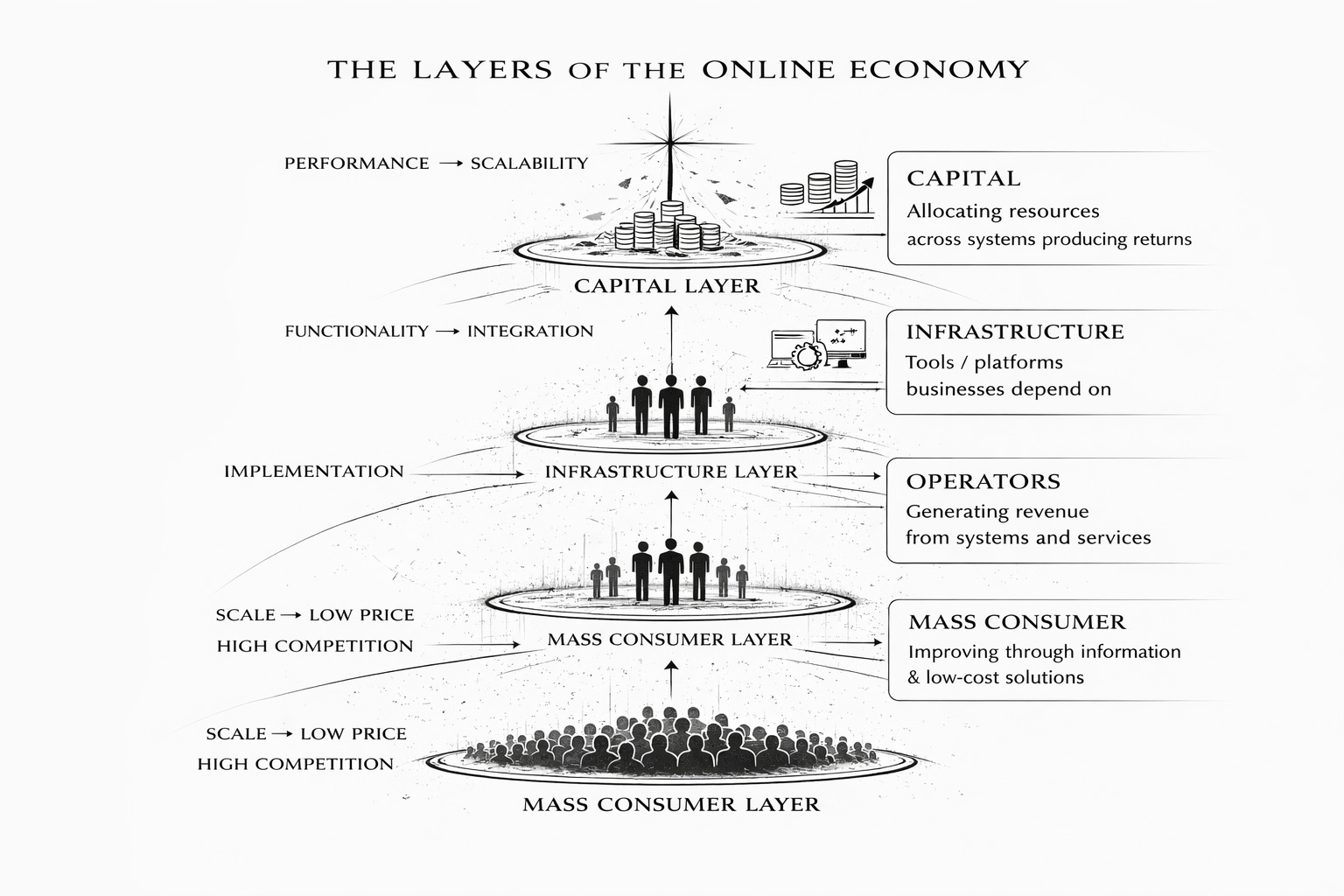
Mass → Operators → Infrastructure → Capital
Across these layers, a consistent pattern appears: the largest number of participants exists at the lowest level, where constraints are highest and conversion is hardest, while higher levels involve fewer participants but greater spending capacity and faster decisions.
This explains why focusing on the mass market often leads to high effort with limited return.
The Learning vs Earning Paradox
Another pattern emerges when looking at how individuals attempt to participate in this system. The more time people spend learning how to make money online, the less time they spend engaging with actual markets. This creates an imbalance where knowledge accumulates without economic output.
This dynamic is reinforced by the online ecosystem, where much of the content focuses on teaching rather than facilitating participation. As individuals consume frameworks and strategies, they begin to perceive learning as the primary path forward. Over time, this leads to a cycle where information replaces action, and progress is measured by knowledge rather than results.
Learning → Consumption → No Market Interaction → No Output
A gap forms between understanding and implementation. Individuals may know how systems work but lack interaction with real markets where value is exchanged. Without this interaction, knowledge remains abstract and cannot produce results.
This paradox is difficult to detect because learning feels productive. However, without connection to systems that generate revenue, this movement does not translate into outcomes.
The Saturation of Knowledge
As this pattern continues, knowledge loses its relative advantage because it becomes widely distributed. When many individuals consume the same information, understanding alone no longer differentiates. Many people reach similar levels of knowledge, yet few produce results.
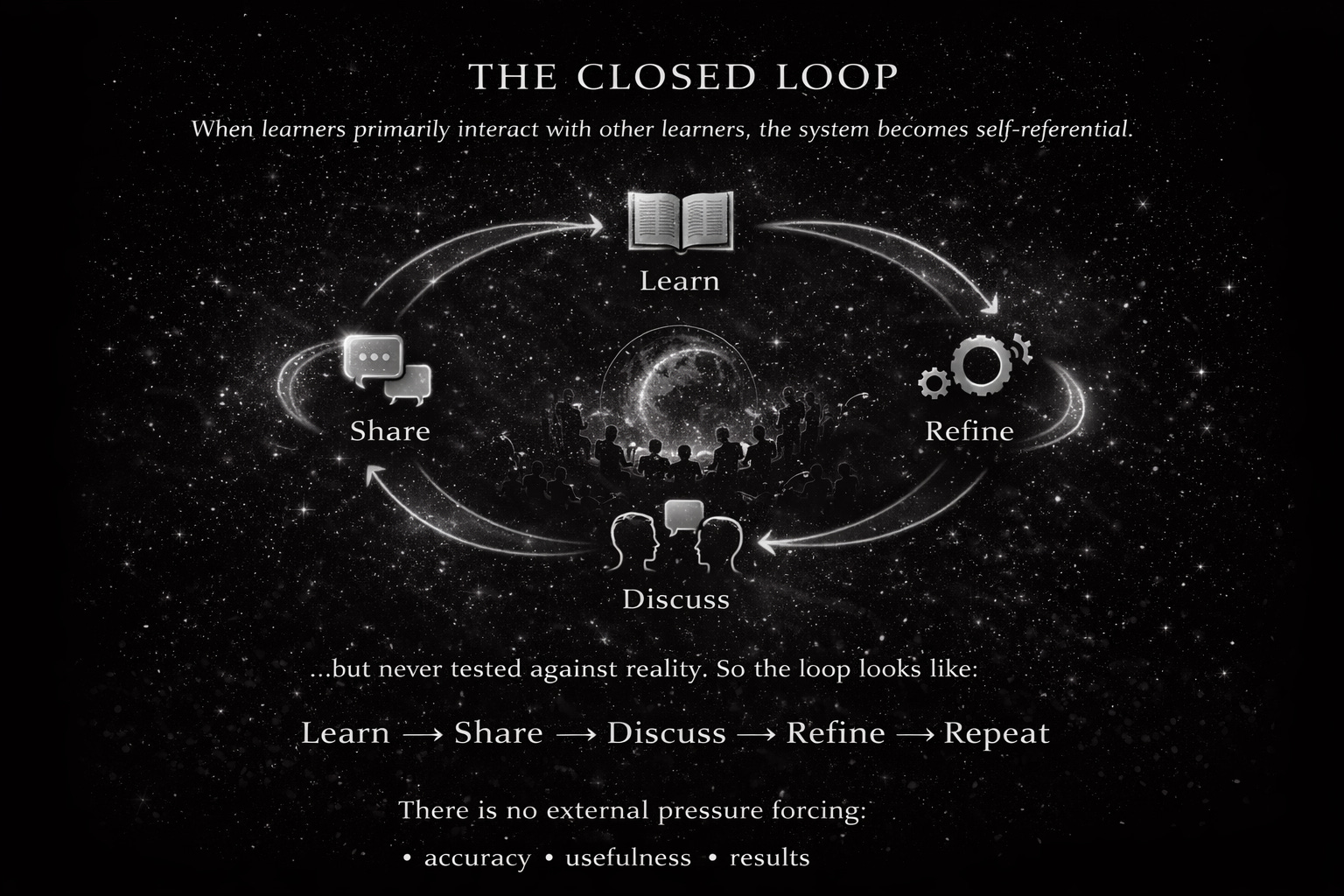
This is reinforced by environments where learners interact primarily with other learners, creating a closed loop where ideas circulate without connection to economic activity. Progress is measured internally rather than through output.
At the same time, the creator-driven model shifts focus toward visibility and audience growth, introducing competition for attention. A small number capture most of it, while others struggle despite having similar knowledge. Effort is redirected toward visibility rather than solving problems within existing systems.
The result is a condition where individuals understand how things work but remain outside the flow of money. Without participation in environments where value is exchanged, knowledge does not compound into results.
Integration as the Resolution
The Clean Truth
It’s not:
“Sell to people who can pay more”
It’s:
Sell to people for whom paying is easy
The core distinction is not between selling to people who have money and those who do not, but between selling to people for whom spending is frictionless and those for whom it is not. Because there is something you also have to keep in mind:
Financial capacity does not automatically translate into willingness to act.
There are individuals with access to capital who still hesitate and overanalyze decisions The difference is not defined by income alone, but by how spending is perceived within their decision-making process.
This shifts the objective from trying to persuade a broad group of people into buying to identifying and engaging with those who already operate within this framework. Instead of increasing effort to overcome hesitation, the focus becomes filtering for individuals whose default behavior aligns with action.
Basically you shift the effort from overcoming objections to filtering people.
This change alters how offers are presented and how interactions are structured. Less emphasis is placed on explanation, justification, or volume, and more emphasis is placed on clarity of outcome, positioning, and alignment with the right type of buyer.