

It Doesn’t Make Sense (Until You Know Why)

This is frustrating to everyone. I am sure you have felt this before. You see people who you know are stupid, let’s just say it, they are really dumb. Many times they cannot string 2 sentences together, it hurts you to even listen to them speak, they are clearly low IQ and you are much smarter and more capable than they are.
BUT, and this is a big but, they make more money than you, they are more relevant than you, they are in a better position financially than you, a position that you feel doesn’t suit them while you struggle, and it pisses you off.
That person probably struggled in school, but is running a profitable business. Probably never read a book on finance and is closing deals. Meanwhile you are well-read, analytically sharp, think deeply, and are a genuinely capable person, but you are just working a 9 to 5, broke and cannot seem to have the life that you want.
This is more common than you think and it should frustrate you. I am going to try my best to explain why this happens. Now don’t think it’s just luck. Luck alone doesn’t explain a pattern this consistent. Something structural is producing it, and that structure starts with a simple but uncomfortable observation:
Dumb people tend to act more, while smart people tend to think more.
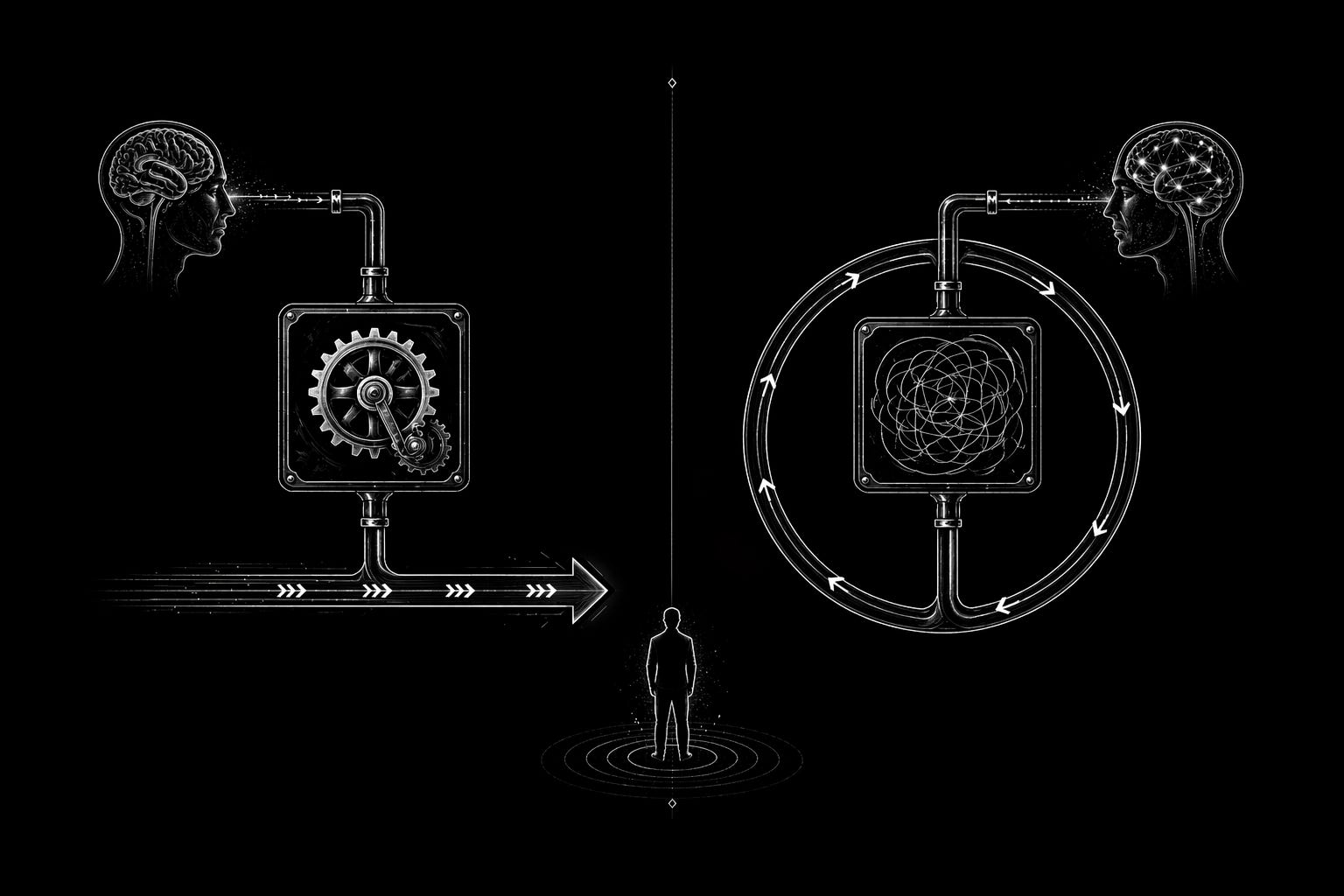
Smart people see the full picture. They understand what it actually takes. They register the risk, the moving parts, the ways things can go wrong, and they respond to that clarity by slowing down. You try to be aware through the knowledge you have. But there is a problem with this.
I go over this deeper in this video:
The world rewards the people that TAKE ACTION. It doesn’t reward you for thinking.
Financial reward rarely flows directly to the person who understands something best. A mediocre idea executed with conviction frequently outperforms a brilliant idea waiting for the right conditions. The market does not grade on accuracy. It responds to movement.
Dumb people tend to move, not think. Most of the time they don’t know what they are doing and they fail miserably a lot, but many times the actions they take, combined with luck, compounding, and time, make something happen.
Luck is not purely random. The more often a person pitches an idea, starts a venture, takes a shot at something, the more opportunities they create for something to land.
So basically what is happening is that the person who acts without overanalyzing is getting lucky more often. They generate luck through motion. Each attempt, regardless of outcome, creates contact with real conditions, real people, and real feedback. That contact produces opportunities that thinking alone never surfaces. The world responds to presence and movement in ways it simply does not respond to preparation. Luck, in this sense, is something you manufacture by showing up repeatedly, imperfectly, and without waiting to feel ready. And what’s funny is that these people do it without realizing it. They just act.
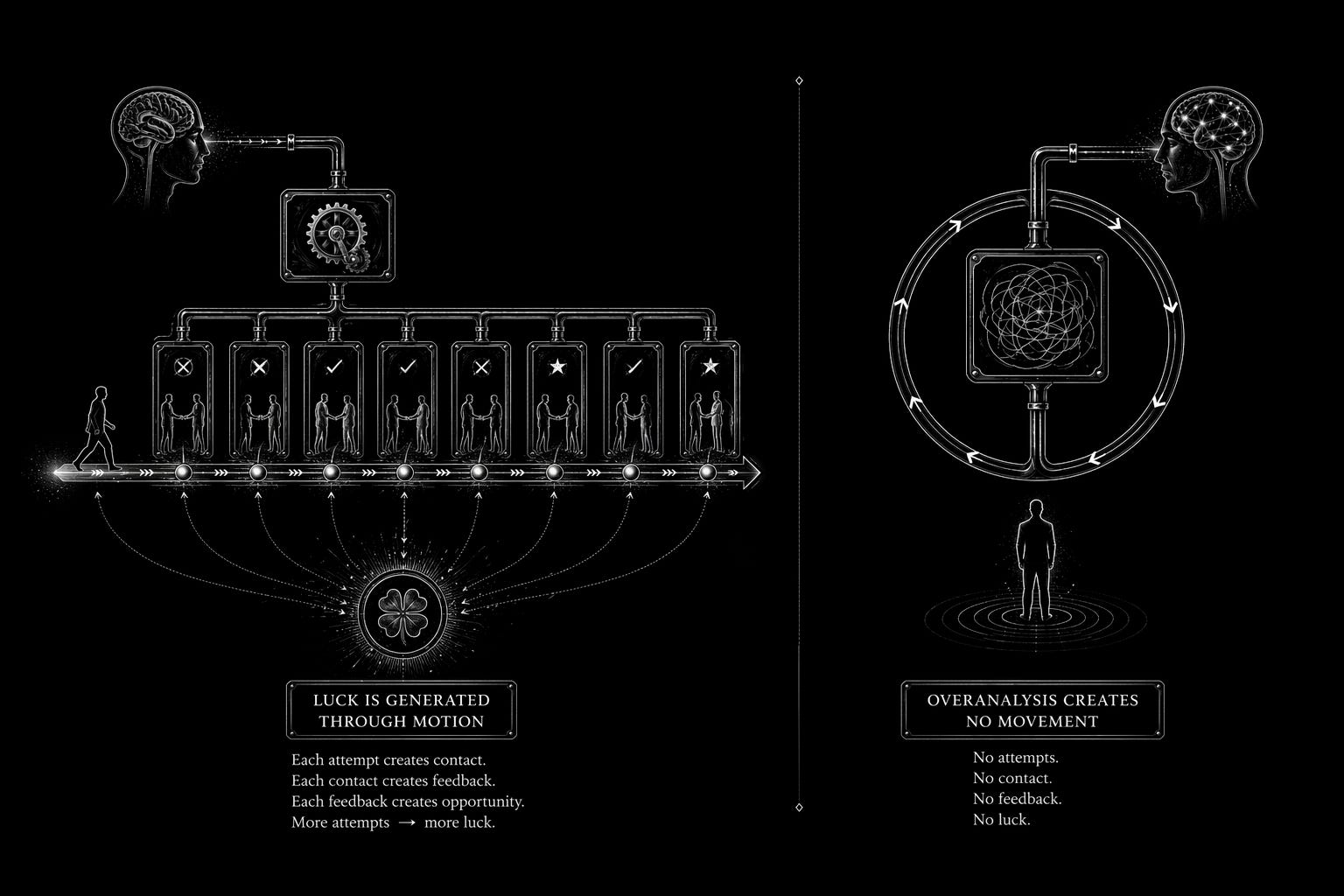
Meanwhile, the intelligent person is running a different process entirely. They research, model, anticipate, and refine. Each of those activities feels productive because they are genuinely producing something: clearer thinking, better understanding, reduced uncertainty. But the market never sees any of it. Nothing enters the world. No contact is made. Nothing externalizes from thinking. The problem with this is that the analysis keeps finding new reasons to wait. People get stuck in this limbo for days, weeks, months, and even years without taking any significant action. So while the smart person analyzes every move, the dumb person makes the moves.
So the smart person:
Runs the numbers
Analyzes what it will take
Checks their time budget and constraints
Understands the challenges
Analyzes their schedule
Questions the model
Tends to have more invested in being seen as competent
Overanalyzes the problem
Is afraid of failing publicly
While the dumb person:
Doesn’t understand what they are doing
Doesn’t know what is going on and what the work will take
Doesn’t think that something is too hard or that they cannot do it, even if they can’t, because many times they are that dumb
Has no idea about the specifics of a situation
Doesn’t carry the weight of people thinking highly of them
Fails publicly often and embarrasses themselves more than they should
But despite all of this, they MOVE MORE than the smart person. They fail, adjust, and move again without the same friction. That turns out to be a genuine structural advantage.
So now you understand what is going on. You can use your advantage of not being dumb as your greatest superpower. Because if you know this, you can do more damage than they can.
The Paradox
The problem is that intelligence, which gives a person their ability to model reality accurately, is their greatest asset AND at the same time what holds them back. You are not wrong about the difficulty, the time it will take, the capital requirements, the failure rates, the competition, the timing risks, and your personal limitations. You see them clearly. But you need to understand this:
The world does not reward accurate perception. It rewards movement.
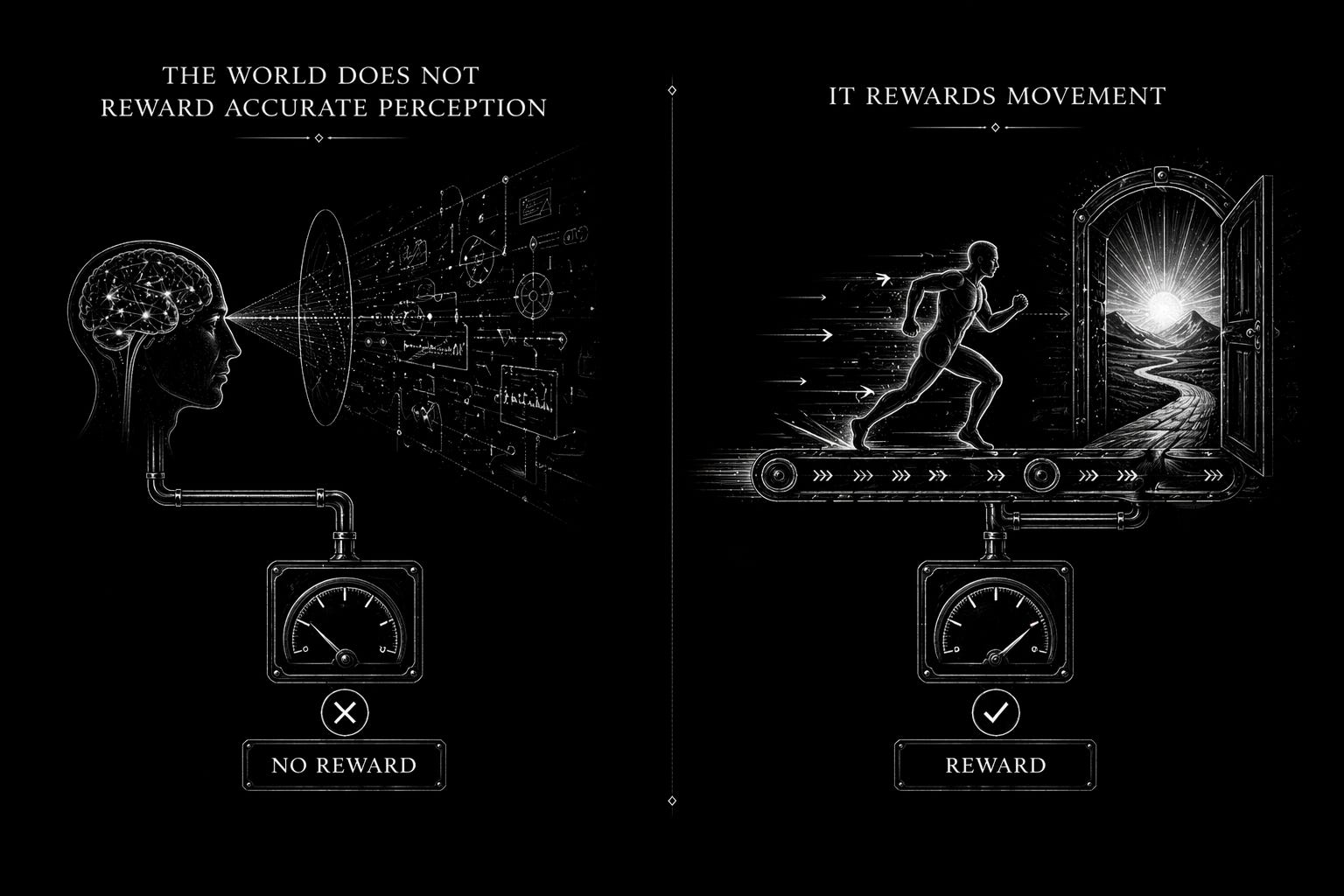
What a lot of the people who managed to make money have is ignorance. And ignorance removes a psychological barrier that knowledge creates. The bold person doesn’t miscalculate risk. They simply don’t load it. They move without the weight of full comprehension, and that lightness allows them to begin. Beginning, it turns out, is the hardest part, and ignorance makes it easier by removing the question entirely.
Thinking and acting do not generate the same kind of knowledge. Analysis produces understanding in the abstract. Action produces contact with reality, and that contact generates information that no amount of thinking can replicate. Meaning you may think you are taking everything into consideration by analyzing more, but no analysis will give you what contact will give you through action, through getting your hands dirty and actually doing the thing. If you feel like you are saving yourself setbacks and can move more linearly by thinking than by doing, you are mistaken. Action is also the research.
So Here Is What You Need to Do
Accept imperfection as the operating condition, not a temporary phase.
Understand that actions will always be imperfect no matter how much you know. Stop waiting for conditions to improve. They won’t. Imperfect action taken now will always outperform perfect action taken later, because later rarely arrives. The standard has to shift from “ready” to “moving.”
Set action deadlines that override analysis
Understand that your internal justification machine will never stop running on its own, so you have to shut it down from the outside. Decide in advance that by a specific date, something enters the world. Not a plan. Not a framework. Something real and visible. The deadline is not a productivity trick. It is the only force strong enough to override a mind that can always find one more reason to wait.
Use intelligence to recover and plan action, not to predict outcomes
Stop trying to think through every possible failure before you begin. That is the wrong application of your ability. Things will go wrong regardless of how well you modeled them in advance. The better use of your intelligence is rapid recovery after reality surprises you, and it will. Think less before. Think harder after.
Just make the first move to get it out of the way
You are probably not starting because you are trying to start at scale. That is your analytical mind setting a threshold high enough to justify inaction. Make the first move almost embarrassingly small. Small enough that even you cannot build a serious case against it. The goal of the first move is not impact. It is momentum.
Treat boldness as a skill you build, not a trait you either have or don’t
The bold person is not wired differently than you. They have simply made enough moves that starting no longer feels dangerous. You can build that same tolerance deliberately. Take smaller, faster, more frequent actions. Every move you make lowers the internal resistance to the next one. You are not training confidence. You are training motion until it becomes your default.
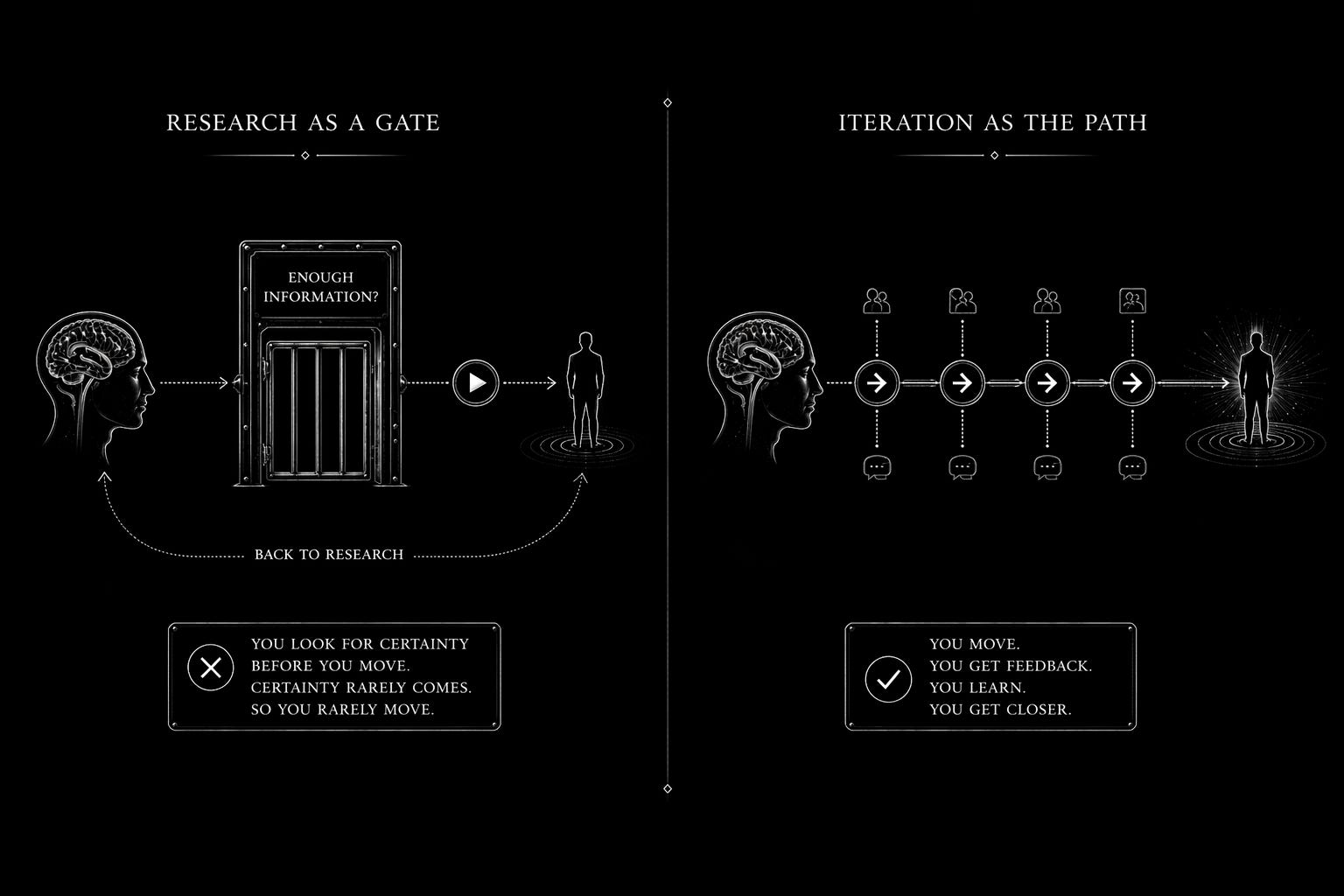
Understand that iteration is not a planning phase, it is the doing itself.
You have been treating research as the way you learn before you act. But most of what you actually need to know cannot be found before you start. It lives inside the process. Every move you make returns real feedback, from the market, from people, from reality, that no amount of research could have given you in advance. The person who launches something imperfect in month one and adjusts in month two knows more by month three than the person who spent that entire time researching. Research tells you what others have already learned. Doing generates knowledge that is specific to you, your idea, your context, and your moment. That knowledge is fresher, more precise, and more actionable than anything you will find in preparation.
Stop treating action as the thing that comes after learning. Action is how the learning happens.